Golf Cart GPS Systems and Golf as a Premium Real Estate Asset Class: Why Investors are Snapping Up Golf Properties
Golf cart GPS systems and on-course intelligence platforms are making golf courses easier to manage. For many years, golf courses were viewed as vanity assets: expensive properties purchased mainly for prestige, lifestyle appeal, or personal passion, rather than for any reliable financial performance.
A golf course requires large amounts of land, massive maintenance budgets, seasonal staffing, and consistent capital reinvestment. On the face of it, this could be a very difficult business to manage profitably in weaker markets. But the perception is shifting.
Today, strong participation, constrained course supply, high replacement costs, and more professional operating models are causing investors to re-evaluate golf courses. A well-positioned course in the modern day can serve as a golf course as well as a diversified hospitality business generating revenue through memberships, public play, food and beverage sales, events, lodging, entertainment, and more.
Of course, this does not automatically make every golf property a strong investment. It all comes down to location, course quality, management, infrastructure, and the ability to deliver a consistently strong player experience. Yet, investors are recognizing how the right golf property has long-term operating potential.
Golf cart GPS systems are making these courses easier to manage by providing objective data on player movement, pace of play, capacity, and course usage. Tagmarshal leads the way in operational intelligence, helping owners replace guesswork with measurable and actionable insights. In this article, we take a closer look at golf as a premium real estate asset class.
Golf Cart GPS Systems: Why Golf Properties Are Attracting Investor Attention

The traditional view of golf courses was that they were vanity properties, often bought by people with a deep love for the game. In these cases, sometimes profits were secondary to status, access, or even personal enjoyment.
Institutional investors look at assets differently. They assess how well the property uses its land, staff, tee sheet, clubhouse, food and beverage operation, and event facilities. They want to understand how much revenue each available tee time generates, how often golfers come back, where operating costs are increasing, and whether the property has untapped potential.
The shift means golf courses are turning into professionally managed operating businesses with the main aim of generating profit. Data, automation, pricing strategy, player segmentation, and portfolio-level reporting are becoming as important as the course’s condition and architectural reputation.
Strong Participation Supports Demand
Golf is no longer seen as a sport only for a specific demographic. Following the resurgence that began at the beginning of the decade, golf participation and rounds played have kept up the momentum. Younger players, women, juniors, and off-course golfers have all contributed to a wider, more diverse customer base.
This growth is important as it means more players create demand for tee times, memberships, coaching, events, food and beverage, and golf-related travel. For an operator in the right market, a wider player base supports stronger utilization and better pricing flexibility.
As such, the opportunity is particularly attractive when demand is rising in an area where the number of available courses is stagnant or falling.
The Supply vs. Demand Disconnect

Among the most important characteristics of golf real estate assets is how difficult it is to create new supply. In the United States, daily fee public-course supply has dropped significantly over the past two decades, while suitable land near major population centers has become more and more valuable for residential, commercial, and mixed-use development.
A golf course requires a large site, extensive approvals, drainage and irrigation infrastructure, turf establishment, a clubhouse, maintenance facilities, and specialist construction. This means that even before any land is purchased, developing a new course can require substantial investment.
As such, new daily fee courses are rarely built in established metropolitan markets. Existing facilities may, therefore, benefit from a scarcity that is difficult to replicate in many other leisure businesses.
Existing Courses Can Gain Pricing Power
When a market has growing demand and limited nearby supply, established operators can gain greater control over pricing and inventory. This may support premium pricing during peak periods, dynamic green fees, differentiated membership tiers, and higher-value corporate or group bookings.
But limited supply must not be confused with guaranteed monopoly. Golfers will still compare courses based on price, conditioning, pace of play, service, location, and overall value. A course that takes demand for granted may quickly lose its repeat customers to competing businesses or alternative forms of entertainment.
Location Remains Critical
Trends don’t tell the full story, and national golf trends do not make every course investment-grade. Investors will still have to assess local population growth, income levels, tourism, climate, accessibility, residential development, and competition.
A course located close to an expanding metropolitan area or established tourism destination may mean a deeper pool of players and events. On the other hand, a remote course in a declining market may struggle, regardless of any broader participation trends.
The value is found in matching a defensible property with an attractive local demand profile.
The 10% to 16% Yield Claim: How Investors Underwrite Golf Real Estate and What to Expect
A golf property is an operationally intensive asset, which means that investors need to look far beyond the purchase price. Due diligence should examine the condition of the irrigation system, drainage, cart paths, maintenance fleet, clubhouse, kitchen, roof, electrical systems, and turf.
The operating model is just as important. Investors should examine the number of rounds played, average green fee revenue, membership retention, food-and-beverage spend, event bookings, payroll, maintenance costs, and net operating income.

A few useful performance measures include:
- Revenue per available tee time
- Average revenue per round
- Percentage of rounds completed on pace
- Membership renewal and churn
- Food and beverage spend per golfer
- Event revenue and forward bookings
- Labor cost per round
- Maintenance cost per hole
- Capital expenditure requirements
There is no universal return range that applies to every golf property. The commonly cited expectation of 10% to 16% yield is more of a myth than any sort of reliable benchmark. While some high-performing assets in strong markets may approach or exceed this range, it is not representative of the broader market and depends on very specific conditions, such as favorable acquisition pricing, operational turnaround potential, or unusually strong demand.
As such, investors should treat these figures with caution and instead evaluate each opportunity based on realistic assumptions around acquisition price, leverage, market demand, operating quality, and future capital needs.
Diversifying Revenue Streams
A course that is dependent entirely on green fees is going to be vulnerable to weather, seasonality, local competition, and fluctuations in participation. The most resilient operators build several complementary income streams around the core golf experience. Let’s take a closer look at some of the ways courses are diversifying revenue.
Membership and Public Play
Membership dues can provide recurring income and improve forward visibility, while public play allows a facility to earn more revenue from a wider market demand. Some operators use several membership levels, offering benefits such as preferred access, discounted rounds, practice privileges, or premium booking windows. This creates options for different player segments without the course operating as either a fully private or entirely public club.

Food, Beverage, and Events
Clubhouse restaurants, halfway houses, beverage carts, weddings, private events, and corporate functions can all become important revenue contributors. Events are incredibly valuable to golf course facilities. Bookings are often secured months in advance, too, so owners get a degree of forward revenue visibility. A golfer may initially visit the facility for a round of golf, but spend more money on food and beverages or a post-round event.
Tagmarshal’s golf cart GPS systems also make it easy for golfers to order food and drinks while on the course, directly from the cart.
Practice and Entertainment
Driving ranges, lessons, fitting services, junior academies, and indoor simulators expand the property’s appeal beyond traditional rounds. Simulator lounges can also add revenue in periods where the weather is poor or the season is slow. This allows facilities to stay active and serve customers throughout the year.
Lodging and Lifestyle Experiences
Larger facilities have the advantage of potentially adding lodging, stay-and-play packages, destination events, wellness services, or residential components. These options mean a whole new stream of revenue for the facility, transforming the course from a single-purpose facility into a wider hospitality venue.
How Tagmarshal’s Golf Cart GPS Systems Help Maximize Tee Sheet Revenue
Tagmarshal is the leader in golf course optimization technology, using the full power of AI and machine learning to provide courses with real-time operational oversight and reporting. These golf cart GPS systems help courses increase revenue from the existing tee sheet, but adding more tee times without understanding capacity can lead to congestion, longer rounds, and poor customer experiences.
As such, the goal is to determine how many groups the course can accommodate while upholding the same standard of service.

How Tagmarshal Determines Available Capacity
Tagmarshal uses real-time tracking and historical pace data to help courses understand precisely how players move through the property. Course operators can then analyze average round times by time of day, day of the week, hole, and player segment.
This data shows when the course has spare capacity and when adding tee times would create pressure. Management can compare performance before and after scheduling changes, rather than just assuming that a shorter starting interval will automatically boost revenue.
For example, at Erin Hills, Tagmarshal reports that data-led tee sheet optimization helps the facility generate approximately $700,000 in additional seasonal green fee revenue per season. As such, investors can use Tagmarshal to turn a tee sheet into a more manageable revenue asset.
Protecting Retention: Connecting Pace Data with Player Sentiment
Higher utilization can improve revenue, but overcrowding can also damage the brand and reduce long-term asset value. Long waiting times, inconsistent rounds, and annoying on-course experiences may lead to poor reviews or member dissatisfaction, not to mention a lack of repeat play.
To protect member retention and public sentiment, course managers cross-reference physical tracking data with customer feedback loops. A facility cannot charge premium prices while delivering an unpredictable or less-than-ideal experience.

By combining Tagmarshal’s objective on-course data with Players 1st golfer feedback, operators can compare round duration and waiting times with satisfaction and Net Promoter Scores. With this level of analytics, private equity boards can monitor the pulse of the property remotely. Tagmarshal gives operators a clearer understanding of the relationship between operational performance and customer satisfaction.
Real-Time Operational Oversight
Tagmarshal’s Live Map gives operators visibility over group locations and pace in real time. Staff can easily identify developing problems before delays spread through the entire field. Rather than sending marshals around the course to seek out issues, managers can direct attention to groups and holes that need intervention, making pace management less intrusive.
Using Golf Cart GPS Systems to Protect the Physical Asset
The golf course itself is a major component of the real estate value, and maintaining it can be expensive. Tagmarshal helps course operators protect the physical asset.
Heatmap Visualization and Geofencing
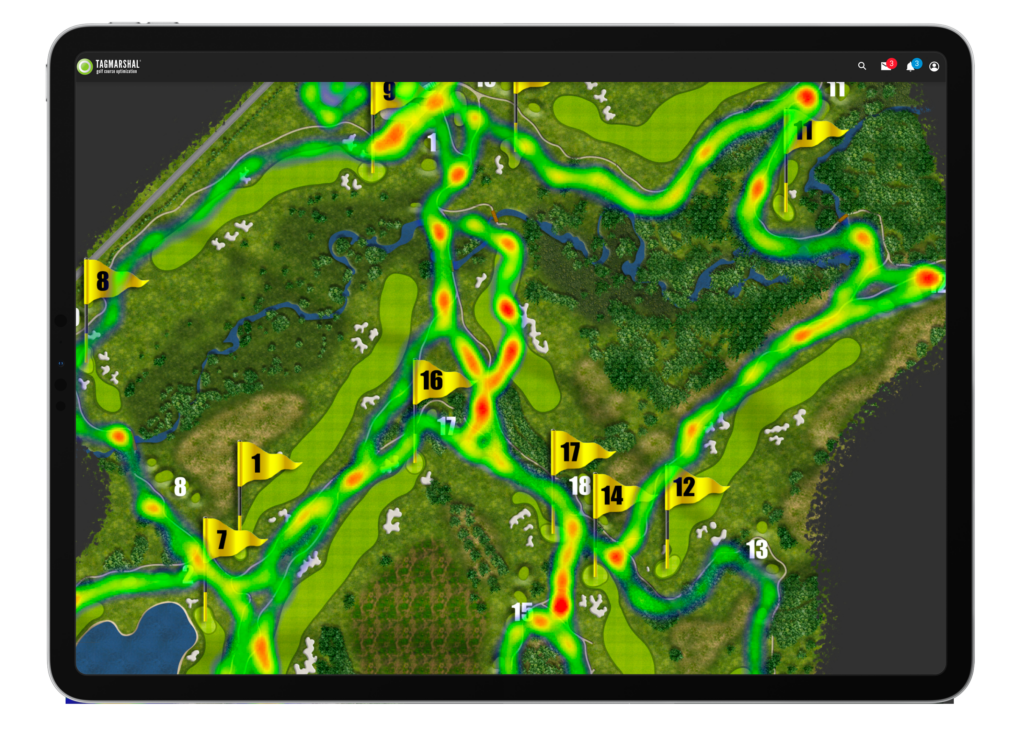
Tagmarshal’s Heatmap Visualization feature shows where carts and walking groups actually travel. As time passes, these movement patterns reveal heavily used routes, underused areas, common entry and exit points, and turf zones experiencing concentrated traffic. Maintenance teams can then focus attention where it’s needed most.
Tagmarshal’s Live Map and GPS Heatmapping features give superintendents and asset managers precise tracking of cart traffic density, which allows maintenance teams to be more precise.
Tagmarshal’s automated geofencing tools can also warn golfers or restrict carts from entering protected areas like newly seeded turf or environmentally sensitive zones.
Smarter Capital Allocation
For investors, the available data supports more disciplined capital planning. Owners can use movement insights to understand which areas impact the most players. This can guide decisions on cart paths, traffic flow, and maintenance needs. Across multiple courses, these efficiencies add up.
Turning Course Data Into Portfolio Intelligence
Institutional owners often need to compare multiple properties. Without consistent data, it can be difficult to identify real performance issues. Golf cart GPS systems create a shared framework for comparison, where managers can assess pace, volume, and player movement across facilities.
Historical data also helps operators be more proactive in management. Recurring bottlenecks or traffic patterns can be addressed in advance, as data shifts operations from reactive fixes to proactive asset management.
The Risks Investors Still Need To Consider
Golf is still a complicated asset class despite its strong operating and real estate appeal. Here are a few of the main risks investors need to consider:
- Maintenance and infrastructure costs can be high.
- Environmental and regulatory factors can impact operations and value.
- Local demand shifts and poor management can quickly erode performance and customer experience.
- Technology can support decision-making, but experienced operators are still essential.
Final Thoughts: Golf Cart GPS Systems and Golf as a Premium Real Estate Asset Class
Golf facilities can offer attractive long-term investment potential, but scarcity and participation growth do not guarantee strong returns. Successful ownership depends on disciplined underwriting, diversified revenue, experienced management, and reliable operational data.
Tagmarshal helps both course owners and portfolio managers identify safe tee sheet capacity, improve pace of play, protect high-traffic turf, support player retention, and compare operational performance across facilities.
Discover how Tagmarshal’s golf cart GPS systems will help your course turn real-time operational data into stronger revenue, improved efficiency, and sustainable long-term asset value. Get in touch or book a demo today!
INVEST IN YOUR ON-COURSE OPERATIONS
Watch Demo
ABOUT TAGMARSHAL
Tagmarshal, the market leader in on-course optimization technology, provides courses with full, real-time operational oversight and reporting, giving golf operators the tools to manage pace and flow of play effectively, resulting in enhanced player experiences, increased efficiency through automation, and additional revenue generation.
Tagmarshal’s technology has collected over 100 billion data points from more than 95 million tracked and improved rounds of golf and has relationships with in excess of 900 partners, including Hazeltine, Whistling Straits, Baltusrol, Fieldstone, Bandon Dunes, The Old Course at St Andrews Links, Serenoa and Erin Hills.
Tagmarshal partners with several golf management groups, private, daily fee, public and resort courses, including 50 of the Top 100 courses, as well as many $40-$60 green fee courses, which are seeing excellent results using the system.
SOLUTIONS
 WATCH DEMO

