The Explosive Growth of Off-Course Golf and Golf Cart GPS Systems
All over the world, we are seeing the incredible growth of off-course golf and golf cart GPS systems. Golf used to be a sport accessible only to those prepared to face the elements, be out and about for hours, and adhere to a specific dress code. But over the last decade or so, the entire landscape of the game and how we used to know it has been changing rapidly. Thanks to the innovation in simulators and GPS systems, golf is moving off the course, and that is not necessarily a bad thing.
Introducing “off-course” golf: the new surge in the way golf is being played, or rather experienced, in the digital age. The so-called “screen golf”, indoor simulators, and practice facilities incorporating state-of-the-art technology have become increasingly popular in recent years. And while traditional golf has seen a major resurgence since the pandemic, off-course golf has been growing just as much alongside it – if not more so. In this article, we look at both the rise of off-course golf and golf cart GPS systems.
Golf Cart GPS Systems: What Is ‘Off-Course’ Golf?

“Off-course” golf can be defined as golf-related activities, where conventional golf is played (i.e., real golf balls are hit and real golf clubs are swung) in spaces away from traditional 9-hole or 18-hole golf courses. These places can include driving ranges that incorporate technology with traditional practice facilities like Topgolf and Drive Shack, or independent indoor venues like golf bars that are ever-increasing in popularity.
Locations like these have been seeing a rise in demand in recent years as they are weatherproof, more accessible, cheaper, and less time-consuming than traditional golf at golf courses. In addition, the technology that accompanies the facilities often adds an aspect of entertainment as the games and features within the technology are much more interactive than simply playing golf. This prospect thus makes it more attractive to families looking for fun ways to spend time together.
Golf Cart GPS Systems: The Rise Of Off-Course Golf
It’s fair to say that golf has broken out of the traditional golf course model in a big way. The popularity of organizations like Topgolf has proven that golf is no longer just to be seen as a sport, but a social entertainment gathering that is open to anyone and everyone, not just established golfers. And the reasons for this are simple:
Gamification and Social Element
On-course golf can be intimidating, especially to new players who may not know the ins and outs of golf courses, their rules, and etiquette. Off-course facilities eliminate this aspect completely through the endless gamification features. Instead of just hitting golf shots, participants play games against one another that make it fun and fair for players of all skill levels. By blending technology, hospitality, and food, these venues make perfect places for a get-together for the entire friend group.

Lower time commitment
Traditional golf is time-consuming. A typical round of 18 holes can take around four to four and a half hours, and even longer at courses without Tagmarshal golf cart GPS systems to maintain pace. In a virtual round, there’s no waiting on slow players or searching for balls – just hitting shot after shot. In a time-sensitive age, getting your golf fix in a fraction of the time becomes extremely appealing.
Weatherproof
In many parts of the world, golf is seasonal, and the weather only permits reasonable playing conditions for a limited time of the year. During the winter, most of the northern part of the USA is deemed unplayable. In the UK, it’s a similar story due to cold and wet conditions for an even bigger part of the year.
On the other side of the weather spectrum, extreme heat can also be a factor that makes playing on the course undesirable at the crux of the day. Indoor facilities circumvent the weather completely and ensure near-perfect conditions all year and all day long.
The appeal to purists
These types of golf facilities also attract “real” golfers by offering something otherwise unattainable – highly accurate simulations of world-renowned courses. This feature allows players to “play” iconic golf courses without leaving their city. The advanced tech allows for realistic conditions, which imitate real play while opening up access to courses that would otherwise be out of reach for the average person.
Furthermore, the high-tech features enable golfers to analyze their every shot on a different level. Golf simulators provide instant, data-driven feedback on key metrics like swing speed, ball flight, and club path, making it easier to identify flaws, track improvements, and make precise adjustments to one’s game.
Taking A Look At The Drawbacks
Most drawbacks of “off-course” golf pertain to player development and growth, which may be insignificant for those only looking to have fun and enjoy golf in an entertainment sense. But if you plan on becoming a hybrid golfer playing both forms, there are some minor downsides to be aware of. Let’s take a closer look at what they are:
Cost
While the initial entry costs can be lower than traditional golf memberships or even golf rounds, premier facilities have quickly built up a reputation for being on the expensive side for a night out compared to alternative entertainment options, especially when considering how much or little golf takes place.
Realism
Off-course and indoor venues are renowned for their lack of realistic on-course scenarios. Many facilities do not have the resources to recreate real golf situations like proper rough conditions, bunker play, or putting facilities, though attempts to circumvent these have been implemented to varying degrees of success.
Absent weather and elements
Off-course golf lacks the conditions of a real course, including the fresh air, natural surroundings, and weather elements that could affect play. Transitioning from climate-controlled, indoor bays to the real thing can be a difficult adjustment for many players when wind and different types of lies are considered.
Low skill development
While driving ranges are great for practicing, they don’t always teach the full challenge of playing on a real course, like course management and using finesse on shots that require it.
Two Formats In Stats – How Do They Compare?
According to the NGF, 48.1 million people over the age of six played either on-or off-course golf in 2025, with 29.1 million participating on the course and 19 million Americans playing off-course golf exclusively, and not accounting for the many who do both. In 2023, it was reported that off-course golfers actually surpassed traditional golfers.
And according to BBC, one of the technology firms within the space predicts, rather boldly, that by the end of 2028, there could be more indoor than outdoor golf rounds played in the UK. They even suggest that globally, up to 80% of all golf rounds could be virtual within the next two years.
Whether those numbers will prove to be accurate or not, it is clear that golf is evolving, and quickly. It’s hard to tell what the future holds in terms of one versus the other, but right now, it can be said that it’s looking good for both off-course and on-course golf.
The Rise of Professional Screen Golf

If the rise in popularity of “screen golf” needed any validation, that validation came in the form of the Tomorrow’s Golf League, or TGL, which made its debut last year. The TGL is a professional, indoor golf league founded by Tiger Woods and Rory McIlroy in partnership with the PGA Tour – that’s right, “off-course” golf has gone professional.
The league features 24 of the biggest names in professional golf, including Tommy Fleetwood, Justin Thomas, and Keegan Bradley, to name a few. The league is made up of six teams that compete against one another inside the SoFi Center, an indoor facility specifically built for this purpose. The center features a massive 64 by 53-foot screen that full shots are hit into, with a physical, adaptive green that changes shape for shots that are shorter than 35 yards.
The league was created to give viewers a fast-paced alternative to traditional golf and attract a wider and perhaps younger audience. One thing is certain: the TGL highlights just how far simulator technology has come, blending real elements with innovative technology to replicate the game at the highest level.
Similarly, in golf-obsessed South Korea, the GTour was established as far back as 2012 and is the game’s first and biggest professional screen-golf circuit with thousands of registered pro players taking part. The competition has held over 200 tournaments and has paid out in excess of $12 million. So, what is perhaps in some light seen as a training aid or entertainment tool is now capable of hosting elite competition, further merging the best of traditional and off-course golf.
Golf Cart GPS Systems: From Off-Course To The Fairway

The modern golfer approaches the game in a much different way than a golfer of a decade ago. New golfers use data-driven, high-tech indoor facilities to get into the game easily, while established golfers use the same technologies for training and improving their games. And when either of these players does want to swap screen golf for a traditional golf course, there is now a different set of expectations.
This is where golf cart GPS systems become pivotal in bridging the gap between entertainment and what can be seen as reality – real golf. Technology platforms like Tagmarshal are bringing the on-course experience right into the digital era where it belongs. 2Way cart screens, course mapping, real-time yardages, and even performance tracking are just some of the ways in which we aid in bringing the off-course experience onto the fairways.
If off-course technology creates new golfers, golf cart GPS systems can certainly help retain them. By bringing the same logic and familiarity to traditional golf, the transition can be much more seamless and less intimidating, especially when you look at all the parallels:
- Instant feedback and immediate guidance
- Data-driven decision making
- Reduced wait times between shots, thanks to pace of play management software
- Modern and innovative feel, ensuring courses stay current
Let’s look at the advantages of GPS systems in the modern game:
Improved Pace of Play
Golf cart GPS systems let operators monitor every group on the course in real time, finding bottlenecks before they become delays. With tools like 2Way cart screens, staff members can also easily communicate directly with players without needing to interrupt. Naturally, this leads to a smoother and more enjoyable playing experience.
Better Player Experience
Today, golfers expect easy and instant access to information. Tagmarshal’s GPS systems deliver accurate yardages to the pin, hole layouts, and hazard information directly on cart screens, removing guesswork and helping players make more informed and confident decisions.
Course Management

With access to actionable data, operators can make smarter decisions surrounding tee sheet management, staffing, and course setup, which ultimately will lead to increased efficiency and revenue. Additionally, courses can improve operational efficiency through automation systems like pace monitoring and real-time messaging.
Increased Revenue Opportunities
With optimized tee time intervals and a better pace of play, courses can accommodate more rounds per day. Additionally, 2Way cart screens create new revenue opportunities for courses through on-screen advertising, promotions, and direct communication with players during their round.
Smooth Transition for New Golfers
Players introduced to the game through simulators and off-course venues are already familiar with digital interfaces and real-time feedback. Golf cart GPS systems, therefore, make it easier for them to adjust by offering instant feedback, precise yardages and interactive visuals. This, as a whole, makes traditional golf more accessible and less intimidating.
Tagmarshal’s GPS Systems – More Than Just Bridging A Gap
It is clear that off-course golf is growing at a rapid rate and will most likely continue to do so. The question of whether it will surpass traditional golf remains to be seen. In a perfect world, both formats will be thriving as they are at the moment, and one would not need to compete with the other. Rather, each has its place where they can co-exist, where people have their preferences. All we know is that no traditional course can afford to get left behind.
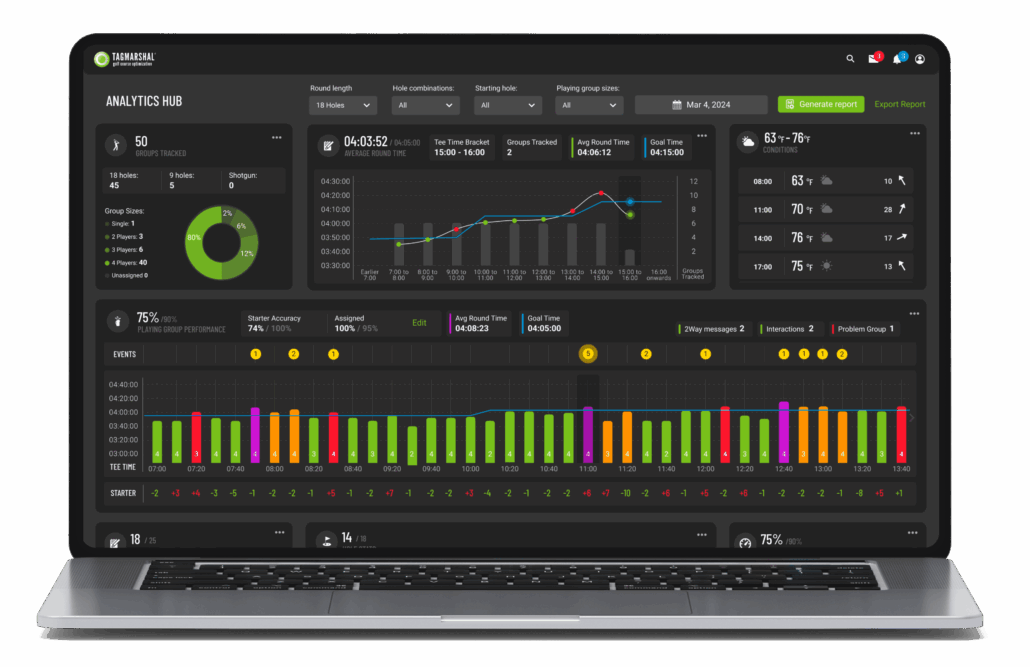
Tagmarshal’s GPS systems technology plays a significant role in bridging off-course and on-course experience for golfers, and the numerous, comprehensive system features cooperate to deliver data-driven decision-making and identify opportunities for improvement, allowing you to do more with fewer resources.
If this sounds like something that could benefit your course or club, be sure to reach out to us today, and we’ll help you take your course to new heights!
SEE HOW TAGMARSHAL OPTIMIZES ON-COURSE OPERATIONS
Watch Demo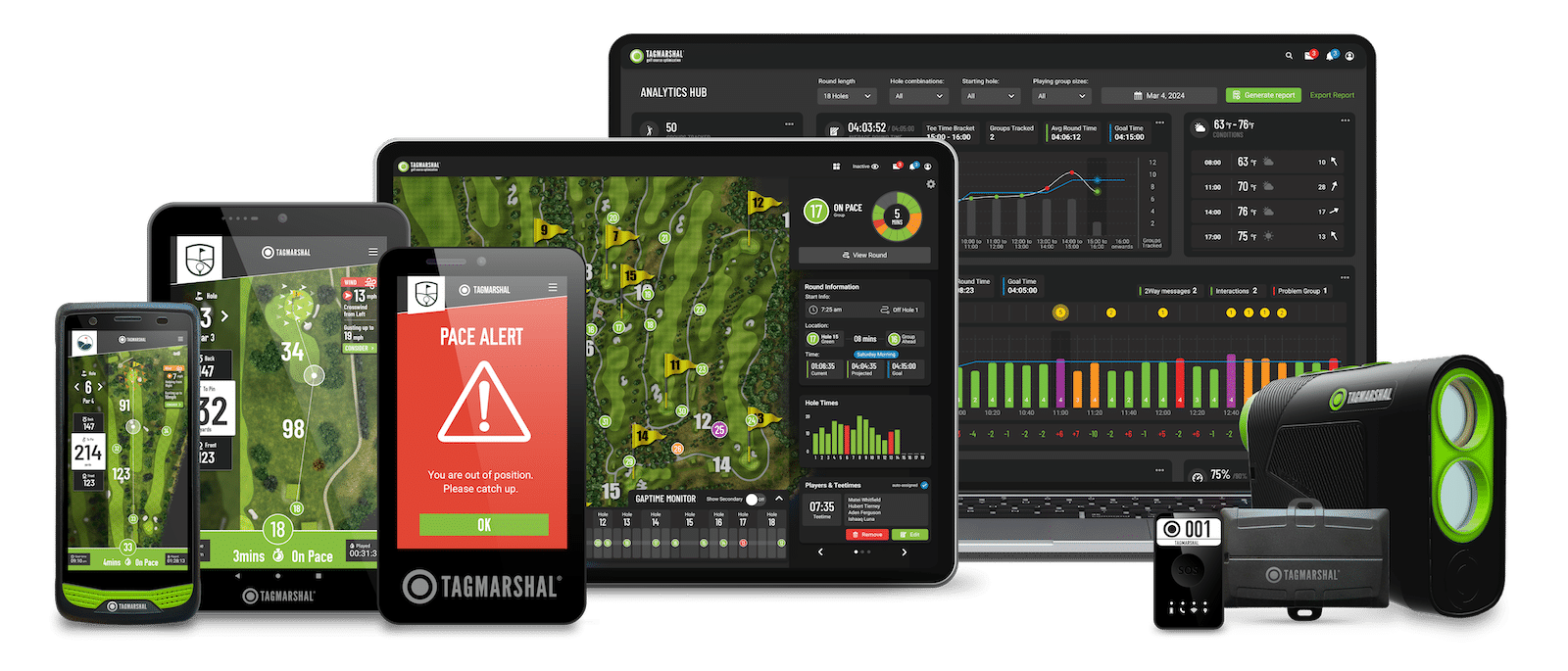
ABOUT TAGMARSHAL
Tagmarshal, the market leader in on-course optimization technology, provides courses with full, real-time operational oversight and reporting, giving golf operators the tools to manage pace and flow of play effectively, resulting in enhanced player experiences, increased efficiency through automation, and additional revenue generation.
Tagmarshal’s technology has collected over 100 billion data points from more than 95 million tracked and improved rounds of golf and has relationships with in excess of 900 partners, including Hazeltine, Whistling Straits, Baltusrol, Fieldstone, Bandon Dunes, The Old Course at St Andrews Links, Serenoa and Erin Hills.
Tagmarshal partners with several golf management groups, private, daily fee, public and resort courses, including 50 of the Top 100 courses, as well as many $40-$60 green fee courses, which are seeing excellent results using the system.
SOLUTIONS
 WATCH DEMO

