Golf Cart GPS System: Golf Scoring Explained
In the age of golf technology and the golf cart GPS system, understanding the basics is still as important as ever. Golf is a game of skill, technique, and strategy, but arguably its most important aspect is its scoring.
And while the primary objective of the game remains to get the ball in the hole in the fewest number of strokes, golf scoring can take on many different forms, each with its own rules and nuances. Whether it’s stroke play, match play, Stableford, or anything in between, beginners and seasoned players alike can have a hard time wrapping their heads around different formats.
This article will focus on different types of scoring within the game of golf and provide clarity on golf scoring and how Tagmarshal’s golf cart GPS system can aid in keeping score on the course with some new features.
Golf Cart GPS System: Different Types Of Scoring
It’s safe to say that there are myriad formats of play in golf and, in turn, the scoring thereof. However, three types of scoring are most commonly utilized: stroke play, match play, and Stableford. We’ll take a closer look at each one of them in greater detail.
Stroke Play

Stroke play, or medal play as it is also referred to, is the most common form of scoring for the majority of PGA events. It’s also the simplest way of scoring, as you simply keep track of the number of strokes played and record it as the score. At the end of the round, all the strokes get tallied, and that would be a player’s gross score.
In amateur play, a variation of this format includes net scoring, in which case a player’s handicap is subtracted from the final score to determine the net score. As professional players don’t have handicaps, net scoring is not applicable on the professional tours, and, for the most part, professionals play stroke play for the majority of tournaments.
Conversely, some drawbacks of stroke play include that it can take only one bad score on a single hole to ruin an otherwise good scorecard. In this sense, stroke play is less forgiving than other formats, especially for beginners and high handicappers. In addition, because it is required for every shot to be played, rounds take longer to complete, which adds to the slow play issues many clubs face nowadays.
Match Play
In a match play scoring format, you compete hole by hole against your opponent(s) rather than the overall score of a round. The winner is still determined by the player or team who scores the best on the hole and is essentially awarded a point for each hole.

Whoever wins the hole goes ‘1 up’ or, contrarily, ‘1 down’ if the hole is lost. If there’s an equal outcome, the hole is ‘halved,’ and no points are awarded. A match ends when a player is more holes up than holes that remain and is declared the winner.
The scoring terminology:
- 1 up – the referenced player leads by one hole.
- 2 down – the referenced player trails by two holes.
- All Square (AS) – a tied match where all players have won an equal number of holes.
The end of the match can come when a player is 3 up with 2 holes to play (the opponent can’t catch up the number of points relative to the number of holes left, and the match is over). This is then written as ‘3 & 2’. If a player won at ‘1 up’, the match went all the way to the 18th. 2 & 1 would mean that the match was won on the 17th hole, and ‘4 & 3’ would mean that the match was won on the 15th.
On the flip side, “Dormie” in match play is when a situation is reached where a player leads by the same number of holes that are left to play. This means that the leader cannot lose the match, but the trailing player, or team, can still tie the match. For example, being 3 up with 3 to play.
It’s worth noting that match play can be played in two ways: scratch match play or handicap match play. The format stays the same, where players compete hole by hole, but the way a player wins the hole can differ.
In scratch match play, no handicaps are applied. Both players compete on equal terms, and the winner of each hole is simply the player who takes the fewest strokes on that hole. In handicap match play, strokes are used to level the playing field between players of different abilities, and relative to the stroke index of a hole.
If the stroke index is lower than the handicap of one player and not the other, the higher handicap player receives an extra stroke. For example, if the higher-handicap player makes one more stroke than their opponent on a hole where they receive a stroke, the hole is halved rather than lost.
Match play scoring is the preferred method of scoring in team matches like the Ryder Cup, as well as the President’s Cup, as it ensures a competitive head-to-head dynamic that isn’t as easily replicated in stroke play. It has long been said that stroke play measures how well you played, and match play measures how well you competed.
Stableford
The third most common type of scoring in golf is what is known as Stableford. Stableford is the form of scoring that most incorporates a player’s handicap. It is designed to be more forgiving, making it more enjoyable for players with high handicaps and/or beginners.

Instead of adding up all strokes at the end of the round as in stroke play, players score points on each hole. Depending on the number of shots taken, the stroke index, and a player’s handicap relative to the stroke index, a score is awarded as points. The aim is to finish with the highest number of points.
The score on each hole is normally compared to the par of that hole. The Stableford system gives zero points for a double bogey, one point for bogey, two points for par, three points for birdie, four points for eagle, and five points for the rare double eagle or albatross. So, the better you score on a hole, the more points you receive.
Handicaps are built into Stableford, which makes it a fair format for players of all skill levels. The stroke index of a hole determines the difficulty of that hole relative to the other holes on that course. Simply put, if the stroke index reflects a number lower than a player’s course handicap, that player receives an extra stroke on the hole to score points.
The biggest advantage of Stableford is that a single bad hole does not have the ability to ruin a round as much as it would in stroke play. Due to this, Stableford is the preferred method of scoring for corporate golf days, social competitions, and fields where there is a wide variety of playing ability. The format encourages aggressive play, rewards good holes, and greatly speeds up the pace of play as players can just pick their ball up when they’re out of contention on a hole.
Other Common Tournament Formats
Beyond stroke play, match play, and Stableford, many competitions use team-based formats designed to make golf more social and inclusive. Among the most popular of these formats is the Scramble, where all players hit a tee shot, the team selects the best ball, and everyone plays from that spot until the hole is completed. This helps speed up play and is common in corporate or charity events.
Fourball, or Betterball, involves two-player teams where each golfer plays their own ball, and the lowest score on each hole counts for the team.
Foursomes, another format, also known as alternate shot, requires teammates to take turns hitting the same ball, demanding strategy and teamwork. Other tournament variations like Texas Scramble, Shamble, and Skins add further variety, so tournaments remain competitive, fair, and enjoyable for players of all abilities.
How Penalties Affect Scores
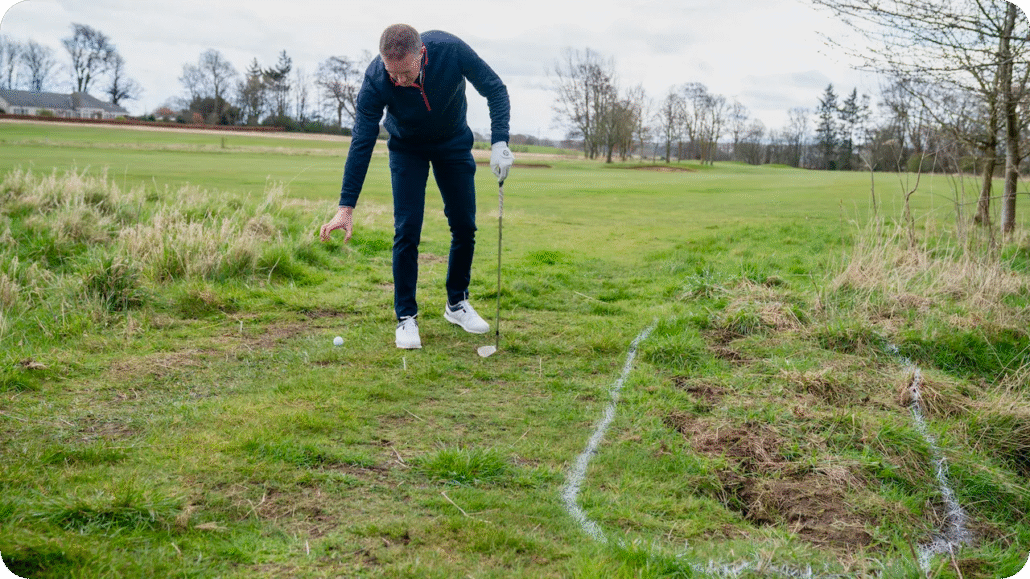
Penalties are a key part of golf scoring and can greatly impact a player’s final result. In stroke play, most common infractions, such as hitting a ball out of bounds, into a penalty area, or declaring an unplayable lie, result in a one-stroke penalty.
In some cases, like out of bounds or a lost ball, players must replay the shot from the original position under stroke-and-distance, adding both the penalty stroke and the replayed shot to the score. In match play, penalties can differ. While many rule breaches still carry a one-stroke penalty, certain violations result in loss of a hole rather than added strokes.
Understanding when penalties apply and the relief options available is important for keeping an accurate score and maintaining fair competition across the field.
Keeping Accurate Scores On The Course
Each player has the responsibility to keep an accurate score. This is key to fair competition. It doesn’t matter if you’re using a traditional scorecard or a golf cart GPS system; attention to detail matters.
In stroke play:
- Each player is responsible for the accuracy of their hole-by-hole score.
- A marker (usually a playing partner) records your score.
- Scores should be confirmed after each hole.
- At the end of the round, the scorecard must be signed by both player and marker.
- Submitting a lower score than actually taken will lead to disqualification.
In match play:
- Players track the result of each hole (won, lost, or halved).
- The match score reflects holes won versus holes remaining.
Golf Cart GPS System: Golf Genius Integration

As a leader in pace of play management that is always looking to enhance the player experience, Tagmarshal has now integrated with the worldwide leader in tournament management solutions to bring users a new dynamic when playing social and local tournaments. Courses that utilize the Tagmarshal golf cart GPS system and Golf Genius can now have direct access to live scoring and leaderboards, right on the course while play is underway.
On the 2Way screens, this innovation enables players in a tournament to track their own and their competitors’ scoring in real time and adjust strategy and tactics accordingly. The golf cart GPS system’s location tracking prompts golfers to submit their scores after each hole, which ensures that leaderboards are always up to date.
How Tagmarshal’s Pace Management Supports Fair Competition

In tournament golf, scoring integrity depends on consistent playing conditions across the entire field. If groups fall significantly behind, uneven circumstances can develop, such as shifting weather, changing green speeds, or delays that impact rhythm and concentration.
A golf cart GPS system with live tracking allows staff to quickly identify slow play and intervene proactively, maintaining a steady flow across the course. When paired with live scoring through Golf Genius, tournament officials gain real-time visibility of both pace and performance, so every competitor plays under comparable conditions.
Golf Cart GPS System: Tagmarshal Integrations
As the market leader in on-course optimization technology, this shows how easily integrations between our golf cart GPS system and different types of software are possible.
Tagmarshal boasts a list of over 25 integration partners, including the likes of ForeTees, Lightspeed, foreUP, Jonas Club Software, and ClubProphet. Feeding this information into the Tagmarshal software platform means that clubs can build out extensive data sets for particular players and create profiles, which opens up a number of possibilities.
As technology continues to evolve, seamless integration between different systems is more important than ever. You can rest assured that Tagmarshal will continue to be at the forefront of technological innovation and software integration.
Final Thoughts
If you or your club is ready to take control of pace of play while elevating experiences for both golfers and staff, it’s time to get in touch with us today. Tagmarshal gives you real-time visibility of your course, actionable insights, and analytics to get the most out of your course in the most affordable way.
Whether you’re looking to manage pace of play, improve operational efficiency, or simply deliver a better day on the course for your golfers, there’s no better time to give Tagmarshal a call. Contact us and see firsthand how data-driven course management can transform the way your course performs.
ABOUT TAGMARSHAL
Tagmarshal, the market leader in on-course optimization technology, provides courses with full, real-time operational oversight and reporting, giving golf operators the tools to manage pace and flow of play effectively, resulting in enhanced player experiences, increased efficiency through automation, and additional revenue generation.
Tagmarshal’s technology has collected over 100 billion data points from more than 95 million tracked and improved rounds of golf and has relationships with in excess of 900 partners, including Hazeltine, Whistling Straits, Baltusrol, Fieldstone, Bandon Dunes, The Old Course at St Andrews Links, Serenoa and Erin Hills.
Tagmarshal partners with several golf management groups, private, daily fee, public and resort courses, including 50 of the Top 100 courses, as well as many $40-$60 green fee courses, which are seeing excellent results using the system.
 WATCH DEMO
