2026 Rules of Golf Update: New Rules and How Golf Cart GPS Systems Are Shaping On-Course Decisions
Golf is generally seen as a sport rooted in tradition, but in recent years, golf cart GPS systems and updated rules have played a big role. Golf doesn’t change its rules lightly, and when updates do happen, they reflect something about how the game is actually being played.
The 2026 Rules of Golf update follows this pattern. Rather than introducing broad changes across the board, the governing bodies are refining how the game is played in real-world conditions. The emphasis is on reducing confusion, speeding up play, and making rulings easier to apply.
The rule changes won’t feel radically different for most golfers. What will feel different is how often situations need to be interpreted quickly, sometimes without immediate access to an official. This change places more responsibility on players and course operators to manage the flow of play effectively.
And of course, golf technology is quietly becoming a part of that equation. Golf cart GPS systems are playing a major role in decision-making for players, how staff respond to certain situations, and how courses maintain pace. In this article, we look at the updated rules and how golf cart GPS systems are shaping on-course decisions.
Golf Cart GPS Systems: The 2026 Rule Changes
The 2026 updates are best understood as a refinement of the existing framework, rather than a full rewrite of the rules. Many of the changes surround clarifying areas that have previously caused delays or uncertainty. Relief procedures, out-of-bounds situations, and the use of local rules have all been refined to make them easier to apply in practice.
There is also a stronger emphasis on pace of play, which has become one of the most consistent concerns across the game. At both the professional and amateur levels, slow play affects everyone. The updated rules show a growing understanding that pace is a key part of the structure of the game.
The six model local rules introduced for 2026 aren’t intended to apply everywhere automatically. Committees can choose whether to adopt them, which means you’re more likely to see them in professional events and higher-level competitions first. Even so, they give a clear indication of where the game is going.
Internal Out of Bounds Can Apply Only to the Tee Shot
Courses can now define out of bounds in a more targeted way. Instead of an area being out of bounds for the entire hole, it can apply only when you’re hitting your tee shot.

So you might stand on the tee knowing that hitting into the adjacent fairway is out of bounds; nevertheless, if your ball ends up there later in the hole, it may be perfectly in play.
This is mainly about stopping players from taking easy shortcuts or hitting into other holes, which creates both safety issues and unfair benefits. It lets committees control strategy off the tee without the need for complicated penalties.
For players, it gives them important information before they take a shot. Understanding the hole layout becomes more important, particularly when deciding how aggressive to be off the tee.
Relief Allowed for a Ball Embedded in Another Player’s Pitch Mark

This rule addresses a scenario that’s always felt a bit unfair. If your ball plugs into the ground because of your own shot, you’ve always been entitled to relief. But if it plugged into an existing pitch mark, left by someone else, you could be stuck with a bad lie.
The updated rule allows relief in such a situation, but only if it can actually be confirmed that the ball is in another player’s pitch mark. That’s why this rule is mostly aimed at professional events, where officials or broadcast footage can verify what happened.
At the everyday, more casual level, it probably won’t come up often. The intent, however, is simple: you shouldn’t be punished for damage you did not cause. At the highest levels of the game, where these details can be verified, the rule leads to outcomes more in line with fairness.
Reduced Penalty When a Ball Is Moved Without the Player Knowing
This rule change fixes a harsh outcome under previous rules. If a player accidentally caused their ball to move without realizing it, and then played from that new position, they could end up with a two-stroke penalty for playing from the wrong place.
Under the 2026 update, this has been softened. If a player genuinely didn’t see that the ball had moved, they wouldn’t be penalized for playing from the wrong spot. Instead, they get a single penalty stroke for making the ball move.
This is another rule that’s mainly relevant in higher-level competitions where video evidence may be needed to reveal something after the fact. The goal is to avoid punishing players too severely for something they couldn’t reasonably have known.
This is an indication of a wider change towards proportional penalties, making sure that the consequence fits the situation, rather than applying rules rigidly regardless of context.

Relief From Damage Near the Green Can Be Expanded
Before, relief from interference on your line of play was limited to very specific things, like sprinkler heads near the green. Under the new rules, committees have the option to allow that same kind of relief to certain types of ground under repair near the putting surface.
Consider things like damage caused by temporary infrastructure, broadcast equipment, staging, or other setup work. If that damage impacts your line of play, relief can now be allowed in the same way it would be for a sprinkler head.
This is a good way to keep things fair, especially in tournaments where the course may be impacted by external factors. The result is a more consistent standard around the green, where players can expect a fair surface without being penalized for something they had nothing to do with.
More Flexibility Around the Use of Motorized Transportation
Committees still have the authority to restrict the use of carts. That hasn’t changed. What has changed is how mistakes are handled.
If a golfer uses a cart because they believe it is allowed, committees now have more flexibility to deal with it. In the past, it could have led to strict penalties. Now, players don’t have to be heavily penalized for innocent mistakes.

Simplified Handling of Damaged Clubs
This rule update is about keeping play moving. If a club is damaged during a round (as long as it wasn’t through abuse), players now have more freedom to fix it using parts they already have with them. They don’t need to go off and find a replacement or bring in something from outside.
Golf Cart GPS Systems: How These Changes Affect Course Operations
While none of these changes are going to dramatically change how golf is played, they point in a clear direction. Today, the game is more focused on flow, decisions are expected to happen more quickly, situations that used to cause delays are being simplified or clarified, and penalties are being adjusted to better match the player’s aim.
For players, this means less time arguing and more time playing. For course operators and tournament organizers, it presents a different challenge. Maintaining pace and consistency across a full field of players requires communication and visibility. This is where golf cart GPS systems become incredibly important.
Where Golf Cart GPS Systems Fit
As the rules move toward quicker decisions and smoother play, the role of GPS systems and golf technology become harder to ignore. These GPS systems are now about more than just yardages; they’ve become a key part of how the game is actually managed.
Real-Time Visibility Across the Course

Among the biggest challenges for any golf course or operation is knowing what’s actually happening on the course in real time.
Without technology, staff rely on observations, radio updates, or guesswork. Naturally, that approach isn’t always the best. While it works up to a point, it can quickly break down on busy days or during major events.
With cart GPS systems in place, operators can see exactly where each group is on the course at any moment. This standard of visibility changes how decisions are made. Now, instead of reacting to slow play after it’s already caused a backup, staff can be proactive.
Faster Access to Rules Officials
When a ruling is needed, timing is really important. Just a short delay can impact multiple groups behind. Traditionally, the process has been slow. A marshal first needs to be located, an official needs to be dispatched, and by the time they arrive, play has already stalled.
With GPS systems, that process is far more efficient. Staff can quickly determine where the issue is and who is closest to handle it. Officials are sent directly to the correct location, often with a full understanding of the situation before they even get there.
At events where Tagmarshal is in use, this kind of coordination helps reduce downtime and keeps the round moving.

Direct Communication
Instead of waiting for help to arrive, players can now initiate it. With two-way communication built into Tagmarshal’s system, a player can contact a marshal or player assistant directly from the cart.
Questions can be raised immediately, and in some cases, resolved without anyone needing to physically travel to the group. When an official is required, they arrive with context rather than starting from scratch.
Better Decisions Before the Shot
If a player misjudges a distance, doesn’t see a hazard, or chooses an aggressive line without fully appreciating the risk, it can lead to lost balls, penalty scenarios, and delays.
Golf cart GPS systems show accurate yardages and the full layout of the hole, which ultimately leads to players making better decisions. The result is fewer avoidable mistakes, and when there are fewer mistakes, there are fewer situations where the rules need to be applied in the first place.
Proactive Pace of Play Management
The 2026 rules make it clear that pace of play should no longer be left to chance. GPS systems make pace visible, which allows operators to proactively manage it instead of reacting to it.
Operators can compare where they should be and identify gaps early. This is one of the areas where systems like Tagmarshal’s GPS systems are being used at the very highest levels of the game.
Supporting Smarter Course Operations
As a whole, golf GPS systems provide a broad operational benefit. Over time, they paint a clear picture of how the course is being used. Operators can easily see where delays tend to happen, which holes create bottlenecks, and how the player flow changes throughout the day.
Tagmarshal works with operators at the very highest level of the game. For example, Tagmarshal is used at DP World Tour and R&A events to support pace management and on-course coordination. Additionally, what’s happening at these courses is gradually filtering down to everyday, more casual settings.
Tagmarshal’s Golf Cart GPS Systems: Get in Touch Today
The 2026 rules are designed to make the game flow better, leading to fewer delays, clearer decisions, and fairer outcomes. Applying these rules consistently on the course can be a challenge, but with technology, such as golf cart GPS systems, that challenge becomes far more manageable.
If you’re looking to improve pace of play, support faster rulings, and run a more efficient operation, book a demo with Tagmarshal and see how golf cart GPS systems will take your course to new heights.
ENHANCE THE PLAYER EXPERIENCE AT YOUR COURSE
Watch Demo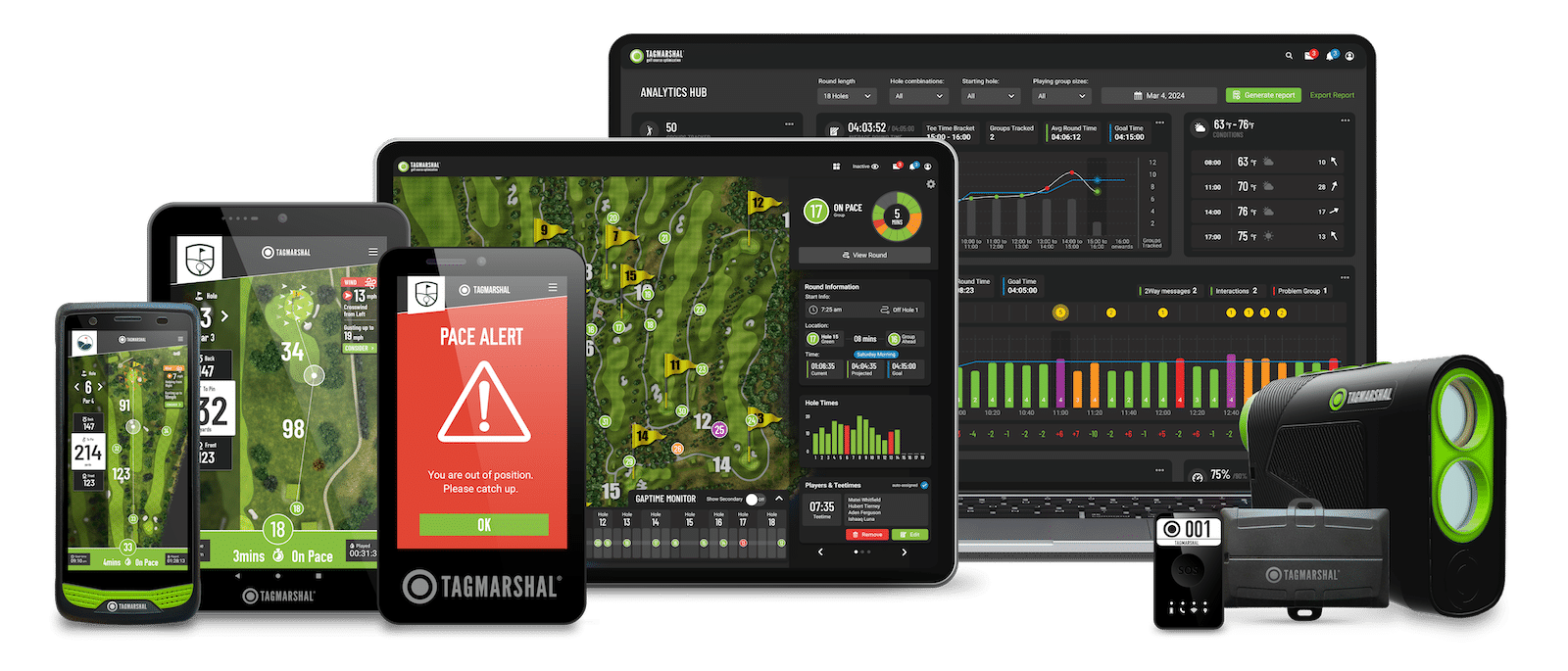
ABOUT TAGMARSHAL
Tagmarshal, the market leader in on-course optimization technology, provides courses with full, real-time operational oversight and reporting, giving golf operators the tools to manage pace and flow of play effectively, resulting in enhanced player experiences, increased efficiency through automation, and additional revenue generation.
Tagmarshal’s technology has collected over 100 billion data points from more than 95 million tracked and improved rounds of golf and has relationships with in excess of 900 partners, including Hazeltine, Whistling Straits, Baltusrol, Fieldstone, Bandon Dunes, The Old Course at St Andrews Links, Serenoa and Erin Hills.
Tagmarshal partners with several golf management groups, private, daily fee, public and resort courses, including 50 of the Top 100 courses, as well as many $40-$60 green fee courses, which are seeing excellent results using the system.
SOLUTIONS
 WATCH DEMO

