5 Golf Cart GPS System Pace of Play Considerations Ahead of Your Next Season
Even though golfers may not play your course for a few months each year, there’s really no such thing as a quiet off-season for busy operators equipped with a golf cart GPS system.
These periods when the course is closed to the public provide the ideal opportunity for you to take stock, looking back on the season just completed and pinpointing where you can improve ahead of reopening.
Alongside standard considerations like budget allocation, it’s always important to continue optimizing on-course operations, especially when it comes to pace and flow of play.
As a top-three player experience factor (USGA research) with the ability to make or break a round, you should continually be considering ways to improve pace and flow.
Here are 5 pace of play considerations that are important for daily fee operators to review ahead of next season.
Tweaking course setup using golf cart GPS system data

Your course setup plays a huge role in maintaining a consistent pace of play, which is why being able to measure the impact of different variables using golf cart GPS system data is so vital.
Until you have a handle on how long each hole takes to play and where on the course players consistently spend too much time and fall out of position, you cannot make informed decisions.
In conversation with your superintendent, consider what a fair height is for your rough in the early weeks of the season. Players may be rusty, so it’s important to give them a little leeway to try and avoid bottlenecks caused by time spent searching for lost balls.
Golf cart GPS system data can also show you where on the course the most traffic occurs, so you can better understand which areas need more leeway and, possibly, protection via geofencing or signage.

With Tagmarshal’s data, we can correlate hole times to specific pin placements and adjust accordingly ahead of busier days.


We used to work out our hole-by-hole times by instinct. Now we have the data to drill down into each part of the hole – tee, fairway and green – and tweak accordingly.


We can see from the hole-by-hole data which pin placements make the hole run longer. That sort of information is incredibly useful.



Pin placement has a huge impact on course flow, affecting run times for each hole. If you are running 10-minute intervals and certain pin placements are too tough and players consistently three-putt, you will experience problems.
On busier days, such as weekends or during tournament and league play, it’s worth considering making certain pin placements easier to ensure a better flow. If the bunching together of groups is largely on the following tee box, a trickier pin placement may actually work in your favor, buying time for the group ahead.
PRO TIP: Tagmarshal’s hole-by-hole stats break down each hole into three parts – time spent on the tee box, fairway and green – giving a more granular view of potential pain points so you can really drill down and adjust setup accordingly.
We’re able to drill down into each hole’s run time and see where we can tighten things up, helping us improve round times and the player experience.


I love the hole-by-hole data, which we use to adjust and tweak expectations to make sure that we are setting realistic pace targets for each hole.


I looked at tracking as a way to see the players’ pace, but the piece that I didn’t expect was using Tagmarshal’s data to understand how our course setup impacts pace, too.


Relying on golf cart GPS system data to inform player assistant training
On-course interactions can make or break a player’s perception of their round, with USGA research showing they serve as both a perfect delighter when things go well and a perfect frustrater when they don’t. Thankfully, golf cart GPS system data is a powerful tool in the hands of your on-course staff.
The first step in the right direction is actively rebranding the role of rangers or marshals at your course, which are traditionally unpopular with players and seen as on-course enforcers. Instead, call them player assistants and drive home the idea that they are to help players stay on pace and have an enjoyable experience, rather than simply policing the field.
By checking our pace data alongside our staff scheduling, we can easily see if anyone requires extra training, which is a big help.


To have the ability to really help the golfer understand their pace through Tagmarshal, and having data to show them, helps these conversations be smoother, friendlier, and easier to manage.


Our best pace-based interactions come from showing data to our members. That way it takes away emotion and they can’t take it personally.


Your staff should also be trained in the language they use during interactions with golfers. Calling a group “slow” is likely to draw a poor reaction, whereas asking them to get back into position and catch up with the group in front will increase compliance.
Encourage staff to engage in positive interactions, too, thanking groups for staying on pace and letting them know about any clubhouse specials or events, or tips for playing certain holes.
PRO TIP: When your on-course staff have tablets, they can show players Tagmarshal’s real-time data, which changes the tone from potentially adversarial to a neutral, fact-based discussion centered on creating a more enjoyable experience for everyone.
We are able to have honest, non-adversarial conversations with golfers thanks to the data and analytics, which we could never have before.


Nobody is ever happy when you approach them about pace, but now we can go straight to a problem group in a way that is data-driven. It doesn’t feel to them like we are singling them out.


Tagmarshal has been wonderful for us, allowing our rangers to be more assertive and we have come on leaps and bounds this year with our pace.

Golf cart GPS system technology and automation

Every available labor hour you have should be put to effective use. As golf cart GPS system technology has evolved, the ability to rely on automation to help with pace management and increase operational efficiency has really come to the fore.
Proactive pace management starts with immediately identifying groups that fall out of position, and carries through into how quickly you can communicate with them. If you are using cart screens, set up automated alerts that are triggered to display on the screen when a group falls behind, which gives players a gentle nudge to improve their pace before staff need to personally intervene.
When your staff do need to intervene, the GPS technology enables them to see exactly where each group is, so they can go directly to the problem. The quicker that touchpoint occurs, the more effective it will be in reducing the likelihood of bottlenecks.
The system does all the work, allowing our team to be more efficient, using fewer staff to get things done.


We used to have two marshals and now we only need one. When groups get behind, we know straight away and send them a message. Our pace is well under what we anticipated.

I’ve set it up so if at any point a group falls 7 minutes behind pace, our staff get a text message. This way, we can constantly track pace without much effort and it’s been awesome.


Course conditioning also impacts pace of play, but ensuring your players do not damage sensitive turf areas can be labor-intensive.


Automating this process with accurate geofencing should be at the front of mind. Not only is it more effective than on-course signage, which is more easily ignored than a breach alarm or forward motion being disabled, but it’s also possible to react in real-time to changing conditions and needs.
Rather than having staff drive the course looking for breaches and adjusting signage, set up alerts that are sent to both players and staff. If a group is consistently entering restricted areas, staff have the data to initiate a conversation and hold them accountable if need be.
PRO TIP: Tagmarshal’s system allows you to draw geofence templates, such as cart path only days or wet weather days, which you can toggle between as needed. The timing of these can also be automated, so that they are active on certain days of the week or times of the day.
It’s unbelievably easy to geofence anything we want with Tagmarshal. In minutes, we can protect high-priority areas and switch between different setups depending on the day and the weather.


The geofencing helps our superintendent protect areas that are overseeded, or have water accumulation. Those are moving targets and putting signs up wouldn’t work nearly as well.


Geofencing is critical for us. If there’s a breach, the screen turns red and the beeping starts. We very rarely have another incident after that.


Tee sheet optimization based on golf cart GPS system insights
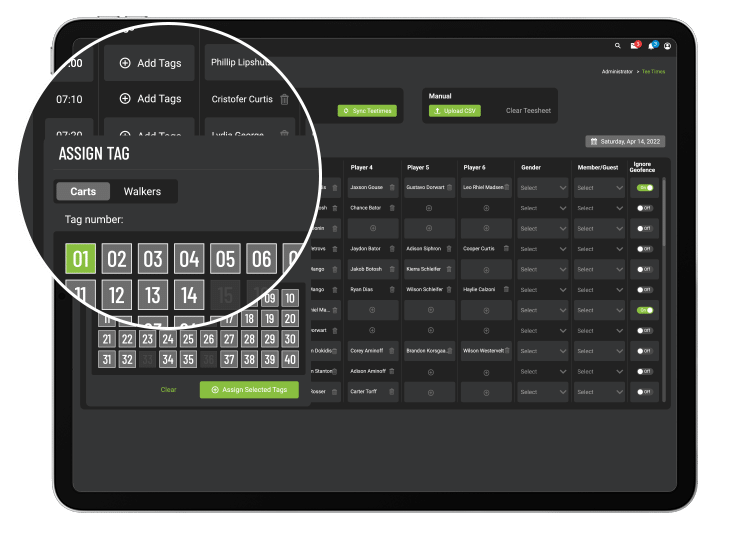
Your operation relies on green fees to generate the vast majority of revenue, and the impact of adding even just a few tee times a week is sizeable. Without the insights provided by a golf cart GPS system, however, you run the risk of adversely impacting the player experience when adding tee sheet capacity.
Take a close look at data from your previous season and identify periods of the day that consistently play quicker. Early rounds often come in well below the average pace across the day, and by reducing your gap intervals, you may be able to gain an additional tee time or two.
If you have already implemented this, use the data to see the impact that adding capacity has had in the hours that follow. If the day grinds to a halt by 11AM, players will not return and any short-term revenue gains will be cancelled out by an unhappy and dwindling player base over time.
When it’s your money, you find ways to make more of it. Tagmarshal enables us to maximize tee sheet capacity while ensuring a quality player experience.


The data has allowed us to optimize tee sheet capacity and improve flow – increasing golf revenue by 85% within 3 years.


Don’t be scared of technology, don’t be scared of data, you have to have it. We’ve taken a stagnant operation, filled the tee sheet and now we’re actually forced to turn golfers away daily.


If you are going to strategically reduce gap intervals, you also need to consider implementing variable goal times across different periods of the day. For example, 8-minute intervals for two hours on weekday mornings may need players to finish their rounds in under 4 hours, whereas later rounds with 10-minute intervals will still have a consistent pace and flow if players finish within 4h15m.
Finally, generating additional tee sheet revenue doesn’t have to mean increasing capacity. If your data shows that certain periods consistently play quicker, you should consider charging a premium for those tee times. More than 50% of golf’s largest age cohort, the 18-34 bracket, is willing to pay 20% more for a quicker round. The trade-off here is that by elevating price, you also elevate expectation, so make sure your team understands the importance of proactive pace management in these time blocks.
PRO TIP: Tagmarshal’s Advanced Reporting feature facilitates a deeper understanding of pace, capacity and other key metrics by breaking them down into tee time blocks, days of the week, days of the month, weeks and months. Using this data, you’ll be best placed to understand where capacity potential exists and when and where your team should focus their attention to meet your pace targets.
The data we obtained early in the season allowed us to determine how we operate the tee sheet for the best flow on our courses.


Adjusting our goal times up in the system helps us set realistic goals for busy league days, and adjusting down on busy weekend mornings sets us up for a good pace day by getting groups through quickly.
“We have been able to adjust tee time intervals and track the impact this has daily. Tagmarshal’s data informs all of our big decisions.
Using your golf cart GPS system to effectively communicate pace expectations

Communications around pace start well before your players arrive on the first tee. Some channels are enabled by a golf cart GPS system, whereas others don’t require this technology.
Look at the entire journey a player has with you, from landing on your website and booking through to post-round follow-ups, and consider where exactly you are letting them know what your pace expectations are.
Your website should include this information, as well as all booking confirmation communications, which should be reinforced when players are checking in and again on the first tee by your starter or with clear signage.
Tagmarshal course partners also have the option to display real-time pace statistics on TV screens in the pro shop or clubhouse, giving players a clear view of course flow before they tee off.
Once a round starts, your player assistants are responsible for keeping communication with players going. If you have cart screens like Tagmarshal’s 2Way 10inch or 8inch devices, players can self-monitor their pace measured against your goal time. Should they fall out of position, automated alerts or personalized messages can be sent to prompt them to keep up with the expected pace.
Being able to send a message before we send someone to the group ensures that by the time our staff arrive, the players know why we’re there. Our customers love it and our staff love it, making sure everybody is on the same page with pace.


The 2Way screens are great. They help players measure distance and they can communicate with us and vice versa. It also keeps them informed on their pace so the course operates at maximum efficiency.


Our members see their pace on the Tagmarshal cart screens and they start managing pace themselves, without us having to have a conversation.


Nobody wants to be the slow player or in the slow group, holding up the course and causing a bottleneck.
When you effectively and consistently communicate around pace, and show that your facility is committed to monitoring this to provide the best possible on-course experience, you’ll find players far more likely to comply.
PRO TIP: Tagmarshal has compiled guidelines for putting together an effective pace of play policy, based on conversations with our most successful partners. Get in touch via [email protected], and we will be happy to assist.
The fact that a member comes into my office after a round and is excited about their improved pace means it’s front of mind and a club culture is built.
We make a pace promise to every player, stating that we will use technology to ensure we prioritize pace and a quality experience. It’s about creating the culture where every staff member knows if we are on pace or behind, based on actual data
Our members know we are making an effort to improve pace and flow of play. Tagmarshal’s system raises awareness among the membership that you’re watching and there’s a lot of cooperation

Conclusion
Each completed season serves as a learning opportunity for you and your team, and each upcoming season is a chance to put into practice new strategies and test their effectiveness.
Multiple factors must work together to create an enjoyable on-course experience for players. Ultimately, though, if your course cannot deliver on the pace and flow front, there is a high likelihood that golfers will leave unhappy.
Each of the considerations listed above may not be suitable for your course, but small changes can lead to incremental improvements that, over time, improve pace and flow of play and help power your course’s economic engine.
 WATCH DEMO
