How Golf Cart GPS Systems and AI Are Transforming Golf Course Design
Golf cart GPS systems and AI-driven systems are changing the way golf courses are designed. For over a century, golf course design was a careful balance of art, intuition, and admiration for the natural landscape. Today, that approach has evolved.
In this new era, golf is being increasingly influenced by data, artificial intelligence (AI), and GPS technology. Golf course architects can now use real-world player data, predictive modeling, and advanced terrain analysis to create courses that are visually gorgeous, highly efficient, sustainable, and of course, optimized for the player experience.
At the center of the transformation are GPS systems and AI-driven design tools. Course architects get valuable information surrounding how the course should be planned, built, and refined over time.
In this article, we’ll take a look at how we reached this point and how technology like Tagmarshal’s golf cart GPS systems is helping define the future of golf course architecture.
Golf Cart GPS Systems and The Evolution of Golf Course Architecture
As we’ve mentioned, we are witnessing an evolution in golf course design. In this section, we’ll take a closer look at how course design has evolved.
The Golden Age of Design (Pre-Digital Era)
In the early days of golf course design, the process was defined by visionaries who relied heavily on instinct and creativity. Architects worked with the natural landscape, creating layouts that felt both organic and strategic, making for exciting, challenging courses.
The decisions made were guided by a visual interpretation of the terrain, experience with how golfers think and play, and a philosophical approach to risk and reward.
Many of these courses still stand out today as masterpieces, but the process itself had its limitations. Designers and architects did not have access to measurable data, and as such, decisions were often based on educated guesswork rather than evidence.
The Digital Age (GPS and Mapping Technology)

The introduction of digital tools was essentially the first major shift in course design. GPS-mapping and computer-aided design software allowed architects to plan layouts with far greater precision. With these tools, course designers could:
- Measure distances and elevations.
- Visualize course layouts before construction.
- Optimize land usage.
In this era, however, designers were still reliant on static data. While mapping improved accuracy, it still didn’t account for how golfers would interact with the course once it was in use. The gap between design intent and real-world behavior was still, for the most part, unaddressed.
Golf Cart GPS Systems and AI: Generative and Predictive Design
Today, we are witnessing another major shift. The AI era is here, and golf course design is benefiting greatly. Now, courses are intelligently modeled and optimized based on real-world data. AI now gives architects the power to:
- Generate multiple course layouts instantly.
- Simulate how players will move through a course.
- Predict pace of play and bottleneck points.
- Analyze environmental and operational factors simultaneously.
In the modern era of golf course design, architects make decisions based on data, simulation, and prediction.
How AI and LiDAR are Revolutionizing Course Planning
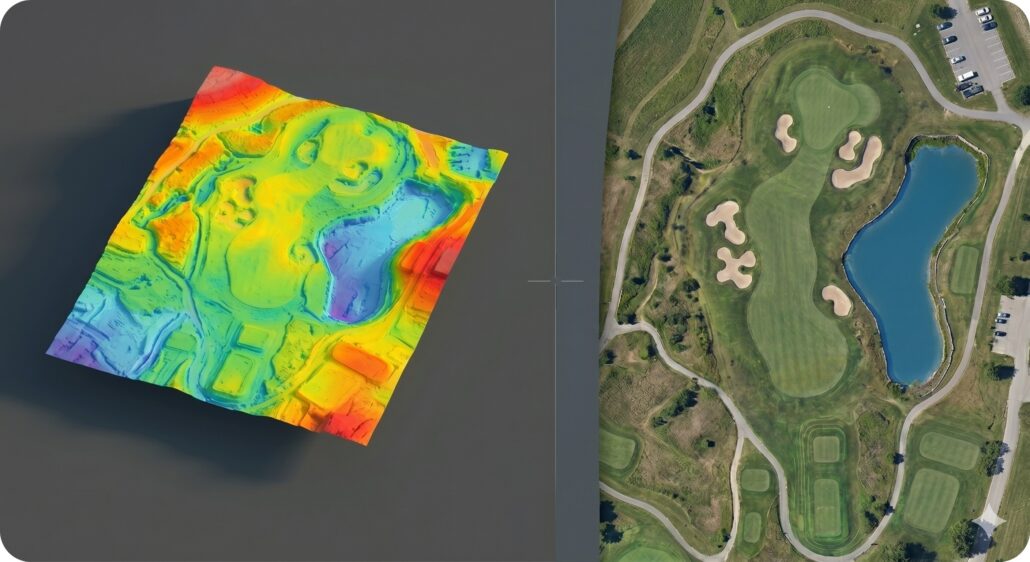
AI and LiDAR (Light Detection and Ranging) technology are among the most powerful combinations in golf course design. LiDAR uses laser scanning to create 3D maps of the land. The maps capture elevation changes, surface contours, vegetation, and any obstacles.
AI processes the data to determine the most suitable design choices. Within just a few minutes, architects have a clear understanding of the most natural routing for holes, areas more likely to end up with water accumulation, and the most suitable locations for greens, tees, and hazards.
Whereas before it would take weeks of surveying and analysis, today, these same feats can be accomplished instantly, and with much greater accuracy.
Machine Learning for Smarter Design Decisions
Machine learning systems help make this process even more efficient by examining multiple factors at the same time. These machine learning systems can evaluate soil composition, slope gradients, sunlight exposure, and drainage patterns.
AI can recommend design solutions that mitigate the construction challenges and long-term maintenance requirements. This means less trial-and-error during the planning phase and leads to more efficient, cost-effective outcomes.
Generative AI: Designing Golf Courses with Precision
Inputs Architects Can Feed into AI Models
AI gives architects the tools to define detailed parameters. This will then automatically generate course designs that meet these requirements. A few examples of inputs include:
- Total acreage of the site
- Desired course type (e.g. par 72)
- Clubhouse location
- Environmental restrictions, such as wetlands or protected areas.
- Routing preferences
- Goals like minimizing earthmoving or protecting natural features.
AI-Generated Layouts and Scenario Testing
After the inputs are designed, the AI systems can produce a range of different design options in just a few seconds. Every layout can then be evaluated based on playability, difficulty, flow, pacing, and environmental impact.
Architects compare outcomes via simulation before any of the actual physical work. This means designers can make decisions with confidence, as AI helps reduce expensive revisions later in the process.
Eco-Friendly Design and Agronomy Optimization
Today, the importance of sustainability is a central focus in golf course design. As such, architects have to consider a range of different factors, such as water efficiency, sustainable turf and grass selection, and smarter design to reduce maintenance.
Designing for Water Efficiency

Another major advantage of AI is the role it’s playing in advancing eco-friendly practices. AI models can use terrain and soil conditions to determine how the water is going to flow. This means architects can:
- Design natural drainage systems.
- Create rainwater collection areas.
- Decrease reliance on artificial irrigation.
The end result is a course that works in tandem with the environment rather than against it.
Sustainable Turf and Grass Selection
With AI, designers and architects can also determine the best drought-resistant grass types for a course. By carefully looking at climate data, soil composition, and usage patterns, this type of system can predict the grasses that will require less water, withstand wear and tear, and thrive in local conditions.
Reducing Maintenance Through Smarter Design
Outside of water and turf, an AI-driven design process can reduce overall maintenance requirements. By optimizing layout and usage patterns, courses can:
- Minimize turf stress in high-traffic areas.
- Reduce labor-intensive upkeep.
- Lower general expenses over time.
As such, course operators can reap the benefits of an efficient, well-designed course that continues to bring in new players.
Tagmarshal’s Golf Cart GPS Systems
AI and simulation are only as effective as the data they rely on. One of the biggest gaps in golf course design has been the lack of real-world player behavior insights.
While designers may intend for players to follow a certain path of strategy, in reality, golfers often behave differently. They take shortcuts, avoid certain areas, and create patterns that are difficult to predict without data. So, how can architects design optimal courses without fully understanding how players actually play?

This is where Tagmarshal’s GPS systems play a huge role. Tagmarshal collects detailed on-course data through GPS-enabled systems, capturing:
- Patterns of player movement.
- Pace of play data.
- Traffic density across the course.
Important features like Heatmaps, Geofencing, and Cart Control tools offer a great view of how golfers interact with the course in real time. Heatmap Visualizations, for example, highlight high-traffic areas, revealing where turf experiences the most wear.
With that information, superintendents and designers can determine problems and opportunities for improvement.
Golf Cart GPS Systems: Using Real-World Data To Train AI Models
The data that Tagmarshal’s golf cart GPS systems gather can be fed into AI and machine learning systems. This means architects and designers can look at real player behavior, which they can then feed into the system.
The Heatmap feature visualizes aggregated player movement across the entire course, which reveals:
- Where golfers tend to walk or drive, often deviating from the intended paths.
- High-traffic zones that experience the most wear and congestion.
- Underused areas that might be overdesigned and over-maintained.
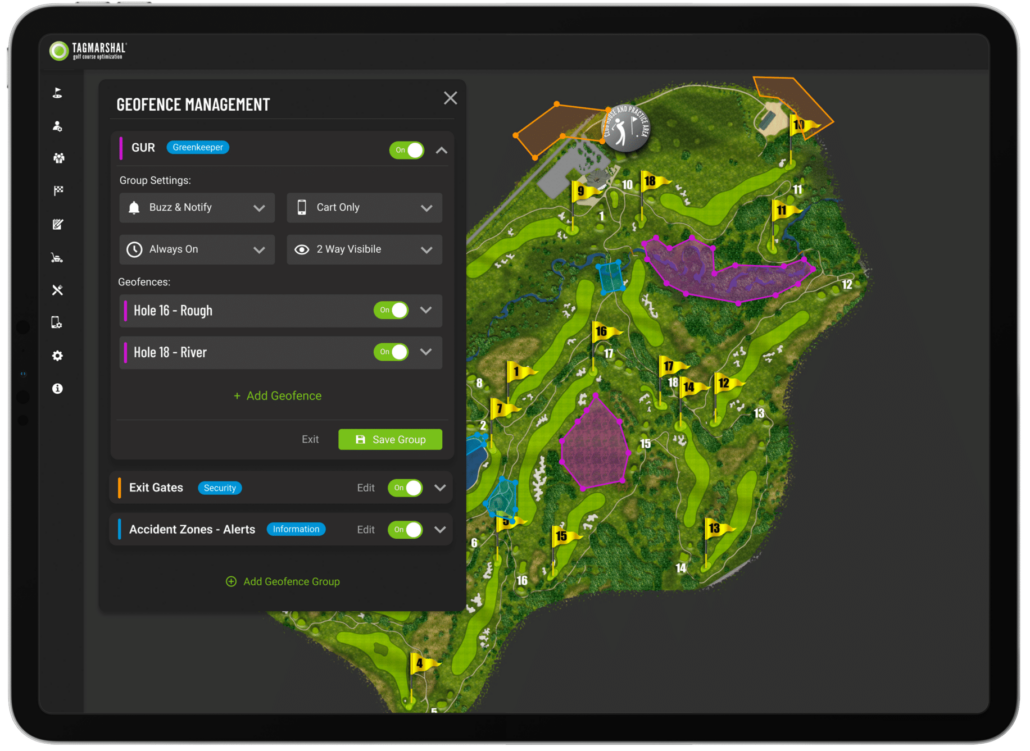
Geofencing technology adds an extra layer of intelligence by defining virtual boundaries across the course. The geofencing tracks how players act in specific zones, such as:
- Restricted or environmentally sensitive areas.
- Cart path vs fairway usage.
- Entry and exit points around greens and tees.
The Cart Stop feature comes with kill switch functionality across 2Way and Classic Installed devices. Carts equipped with 2Way devices will receive a warning when an out-of-bounds area is breached. For Classic Installed devices, the Geofencing Buzzer will sound upon breach, and the kill switch will be activated, meaning they will have to reverse out of the restricted zone.
Together, these features make Tagmarshal an invaluable system, creating a constant feedback loop where player behavior informs AI models, AI-generated designs are validated against real-world data, and courses can be refined with smart, precise decisions.
Partnered with the American Society of Golf Course Architects
Tagmarshal is also in a strategic partnership with the American Society of Golf Course Architects (ASGCA). We have a shared commitment to improving the game of golf through improved design, education, and exceptional pace of play management.
Stemming from the legacy of Bill Yates, a respected golf course architect who always highlighted the importance of proactive pace of play management, his belief that pace and flow are key to the player experience still influences how modern courses are designed, as well as how they operate.
Building on this, we’ve worked with ASGCA to deliver a Pace Initiative, which is a series of workshops and educational courses meant for architects, course operators, and industry stakeholders. The focus is on:
- Educating partners on pace of play and flow from a course architecture perspective.
- Sharing best practices for the most optimal management of pace.
- Showing how technology and data can support better design decisions.
Tagmarshal serves as a bridge between design and operations, helping architects create courses that are efficient, playable, and optimized.
Real-World Impact on Course Design and Renovation
Tagmarshal’s golf cart GPS systems aren’t just for show; they add real value to courses. There are plenty of examples of courses using this data-driven approach to improve design and renovation processes. Let’s take a look:
- Grizzly Ranch used movement data to find underused cart paths. Understanding where players actually drove, the course was able to reduce maintenance efforts and costs without compromising conditions. This led to massive savings on expenses and labor hours.

- Baltrusol used player heatmaps to inform redesign decisions, as they were able to see where players naturally want to move, which improved flow and reduced the need for high-maintenance turf areas. This meant lower maintenance costs overall.
- Pinehurst combined pace of play data with environmental insights, which shows how wind can influence both the player experience and the way the course is designed. They matched Tagmarshal’s pace data with weather data to make informed decisions. Tagmarshal’s industry-first WindTag helps map the “invisible hazard” of wind, giving players and course operators key insights surrounding wind direction and speed.
Golf Cart GPS Systems and The Power of AI: Final Thoughts
We’re currently in the midst of a major evolution in golf course design, and this profound transformation is being led by golf cart GPS systems and other AI tools. AI provides courses with tools to model and predict, while GPS systems help refine them even further. Together, they allow for a smarter and more player-focused approach to design.
As systems like Tagmarshal’s GPS keep bridging the gap between theory and reality, the golf courses of the future are bound to look incredible, perform amazingly, and cost less to maintain as a whole, leading to exceptional experiences for players for years to come.
Get in touch with Tagmarshal today to learn more about how we can help you design, operate, and evolve your course over time!
GIVE YOUR TEAM THE TOOLS TO MANAGE PACE EFFECTIVELY
Watch Demo
ABOUT TAGMARSHAL
Tagmarshal, the market leader in on-course optimization technology, provides courses with full, real-time operational oversight and reporting, giving golf operators the tools to manage pace and flow of play effectively, resulting in enhanced player experiences, increased efficiency through automation, and additional revenue generation.
Tagmarshal’s technology has collected over 100 billion data points from more than 95 million tracked and improved rounds of golf and has relationships with in excess of 900 partners, including Hazeltine, Whistling Straits, Baltusrol, Fieldstone, Bandon Dunes, The Old Course at St Andrews Links, Serenoa and Erin Hills.
Tagmarshal partners with several golf management groups, private, daily fee, public and resort courses, including 50 of the Top 100 courses, as well as many $40-$60 green fee courses, which are seeing excellent results using the system.
SOLUTIONS
 WATCH DEMO

