How a Golf Course GPS System Uses Geofencing to Cut Maintenance Pressure
Golf carts are key to modern course operations, while a golf course GPS system helps operators manage how they move across the property. They improve accessibility, support pace, create convenience for players, and may contribute directly to course revenue. Unmanaged cart movement, however, can also create problems for general managers and superintendents. Every off-path shortcut, ignored cart-path-only rule, and trip across vulnerable turf adds significant pressure to the maintenance program.
The issue isn’t really about one cart in one area. The cost builds through repetition. If hundreds of carts follow the same unofficial routes, drift off the same path edges, or end up around the same green surrounds, turf wear begins to compound. Soil becomes compacted, grass struggles to recover, drainage can suffer, and maintenance teams may struggle with upkeep.
Traditionally, courses have relied on ropes, stakes, and signs to manage cart behavior. Of course, traditional signage does serve a purpose, but it is limited in what it can achieve. Golfers may miss a sign, misunderstand a temporary restriction, or ignore a boundary while looking for a ball. Staff are unable to monitor every cart movement across the property.
A golf course GPS system changes that model. With Tagmarshal’s geofencing, Cart Stop, Heatmap Visualization, alerts, and breach logging, operators can go from passive cart rules to active asset protection. The result is improved visibility, stronger compliance, and a more practical way to protect turf, sensitive areas, and capital investments. In this article, we take a closer look at how geofencing helps cut maintenance pressure.
Golf Course GPS System: Why Cart Traffic Creates a Maintenance Challenge

Golf courses are living landscapes. Turf responds differently depending on traffic, moisture, soil structure, and recovery time. A healthy fairway may handle normal use well, but repeated cart traffic in the same place can cause serious wear. Pressure is highest around fairway entry and exit points, cart-path edges, green surrounds, tee areas, approaches, and rough corridors where players naturally drive, turn, or park.
Wet conditions will also increase the risk. Soft turf can rut, tear, or compact easily. This is why cart-path-only rules often follow rain. Drought or heat stress can create a different problem; the turf may look firm, but if the plant is already under pressure, repeated cart traffic can slow recovery and leave visible damage.
Superintendents need to find where pressure is building before the turf’s decline becomes obvious. Without reliable movement data, teams are dependent on visible wear, staff observation, or complaints from golfers. By then, avoidable damage may already require additional labor, aeration, irrigation, fertilizer, or temporary restrictions.
The Main Turf and Asset Hazards
There are a number of recurring hazards that make cart management difficult. The first is cart-path compliance. Players may leave the path too early, take shortcuts, drive with two wheels off the path, or ignore cart-path-only restrictions.
The second is sensitive turf. Newly seeded sections, repaired areas, low-lying wet zones, and stressed turf around greens or tees need time to recover. If carts enter too soon, the damage can undo the time spent doing maintenance work.
The third is environmental protection. Golf courses tend to have wetlands, native grass areas, tall fescue, habitat corridors, or restoration zones. Cart traffic through these spaces can hurt vegetation, create erosion, and undermine sustainability programs.
Fleet movement also matters. Carts are expensive assets, and operators need to know where they’re being driven. Geofencing can help keep carts away from restricted, sensitive, or higher-risk areas where damage is more likely.

Why Traditional Rules Do Not Always Work
Traditional cart rules need golfers to see, understand, and adhere to the instructions. That works some of the time, but conditions on a golf course change constantly. A hole that is open to carts on Friday may need protection after rain on Saturday, a newly repaired area may need temporary protection for a week, or a native restoration zone may need long-term restrictions.
Yes, ropes and signs can be useful, but they’re incredibly limited. Most notably, they do not alert staff when a player crosses a boundary, they do not record repeat breaches, and they do not show which areas are being ignored most often. A rope and a sign also can’t adjust instantly to weather, maintenance priorities, or event setups.
This is where the golf course GPS system becomes highly valuable. A golf course GPS system can turn cart rules into active operational controls. Courses can alert players in real time regarding compliance breaches, staff members can get alerts when breaches occur, and records can be built of repeat problems. As such, operators and superintendents gain much greater visibility into maintenance needs.
Golf Course GPS System: Tagmarshal’s Active Geofencing Feature
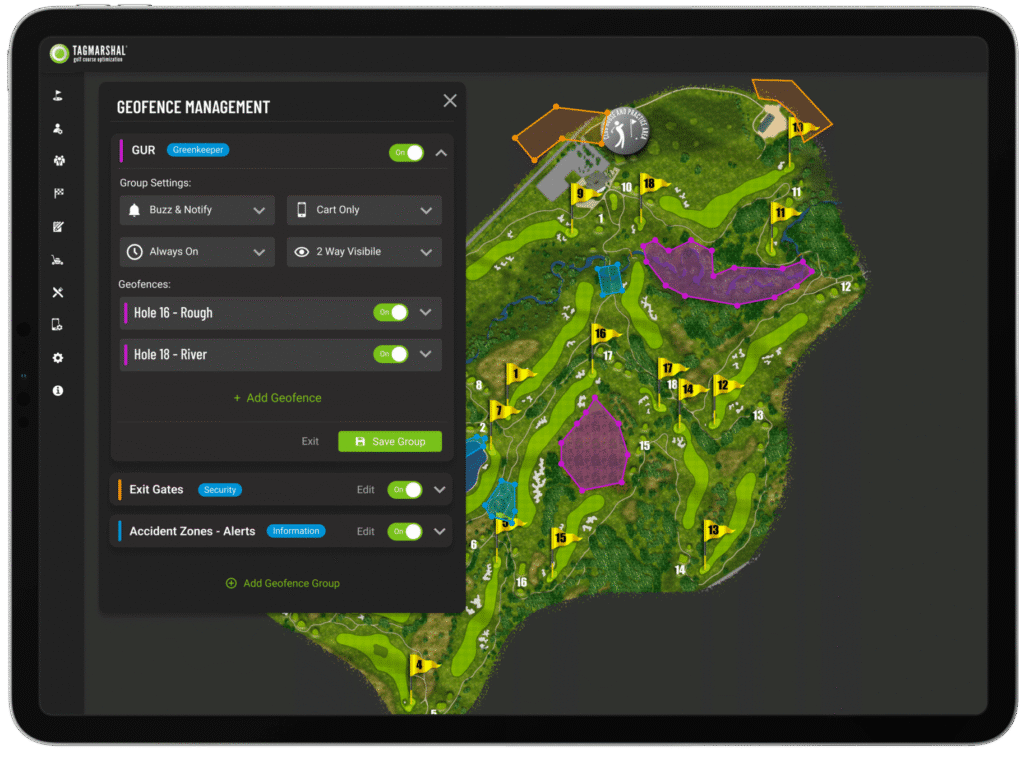
Geofencing creates digital boundaries across a golf course. These boundaries can be placed around wet areas, newly seeded turf, green surrounds, cart-path-only zones, steep terrain, maintenance areas, native grass, or environmentally sensitive spaces.
Tagmarshal’s Geofencing feature allows courses to set adjustable boundaries and templates. These can be activated for certain days, times, weather conditions, maintenance needs, or tournament setups. Such flexibility is important because turf protection is not static. A superintendent may need one setup after heavy rain, another during recovery work, and another during a high-traffic event.
When a cart enters a restricted geofence, the system can trigger alerts. Depending on the device setup, players can receive visual or audible warnings, while staff can also be notified. Golfers are therefore given an immediate chance to self-correct, and course teams are given visibility when intervention is needed.
Breach logging adds another layer of value. Operators can review where and when violations happen, helping them identify repeat problem zones. If the same area is regularly breached, the course can improve communication, adjust routing, add physical reinforcement, or refine the geofencing boundary.
Golf Course GPS System: Tagmarshal’s Cart Stop Feature

In some areas, a warning may not be enough. This is especially true for newly seeded turf, wet low-lying sections, green surrounds, restoration areas, and other sensitive zones. These areas can be damaged quickly if carts continue forward after entering the wrong place.
Tagmarshal’s Cart Stop feature offers managers and operators stronger control for compatible devices. When a cart breaches a protected geofence, forward motion can be disabled. The player must then reverse out of the restricted area before forward movement is restored.
Operators shouldn’t see this as a punishment for golfers; it’s just a way to prevent avoidable damage at the moment it’s most likely to occur. A player who misses a sign receives direct feedback before the cart travels deeper into the restricted zone. Staff, as such, won’t only discover the issue after the turf has been damaged.
Cart Stop is particularly useful during wet weather restrictions, turf recovery, tournament preparation, and areas where the course’s presentation is key.
How Heatmap Data Supports Golf Course Superintendents
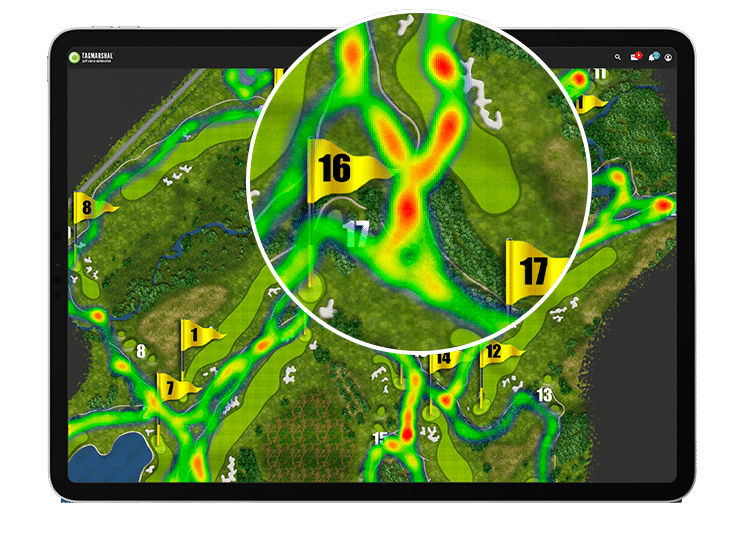
Heatmap data is incredibly valuable for course superintendents and managers, as it helps teams understand where carts actually go. Tagmarshal’s Heatmap Visualization tool shows cart and player movement patterns over time. This means that teams can see heavily used routes, underused areas, recurring shortcuts, and zones where traffic may be contributing to compaction or wear.
Having this data on hand supports a more targeted approach to maintenance. Teams don’t have to treat every area equally and can instead focus on places that receive the most pressure. For example, high-traffic zones may need more aeration, irrigation, fertilizer, signage, routing changes, or temporary protection, while underused areas won’t need the same standard of input.
Heatmaps can also serve as a guide for more long-term planning. If carts repeatedly leave the path at the same location, the course may need a better exit point, clearer messaging, or a future cart-path adjustment. If traffic concentrates around one green surround, the superintendent can protect it before visible damage worsens.
How Automation Reduces Labor Pressure
Manual cart control can take up a lot of time. Staff may need to patrol the course, remind players about restrictions, monitor wet areas, and respond after damage has already occurred. On busy days, this can pull teams away from more valuable work.
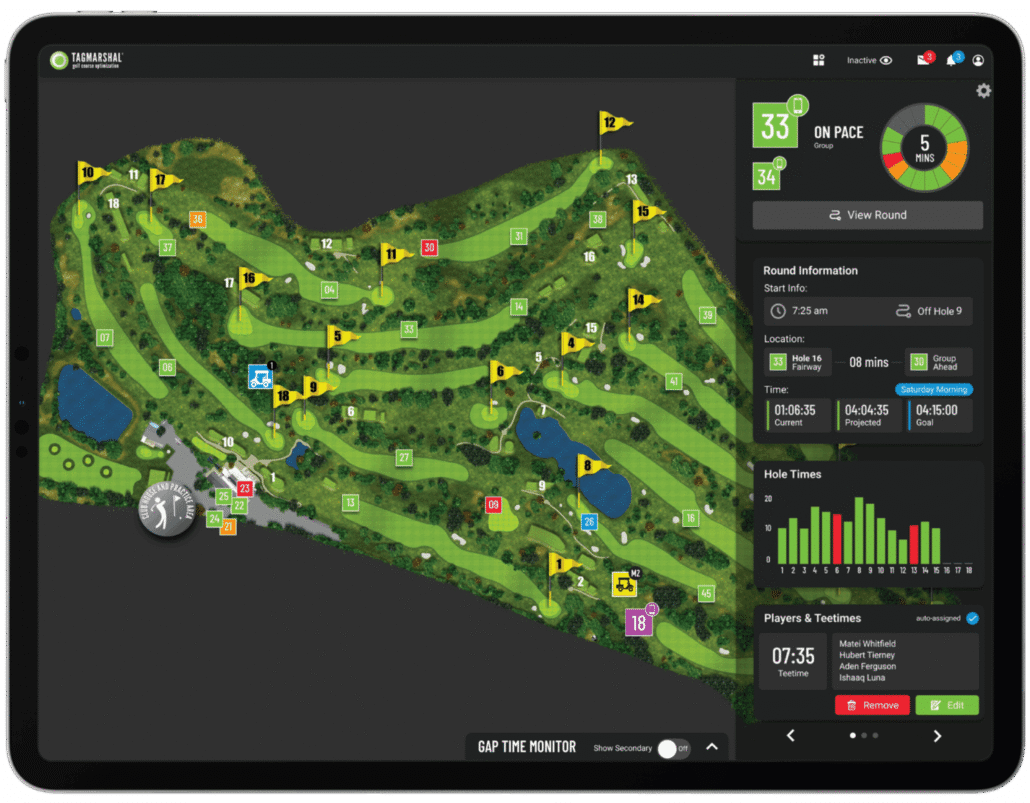
Tagmarshal helps teams reduce this pressure with the power of automation. Geofence alerts notify players and staff when action is needed. Teams can review breach data after each round. Additionally, Live Map visibility shows where groups and carts are across the property, reducing the need for staff patrols, so they can instead focus on specific issues.
Automation is also a great way to support maintenance coordination. Better visibility of group locations helps teams identify gaps and complete work with less disruption to play. Small repairs, setup adjustments, and maintenance tasks can be timed with more precision.
Fleet Management and Risk Mitigation
Golf carts are major capital investments, and unmanaged movement can lead to some major risks. While turf protection is generally the main concern, unmanaged cart movement can also create unnecessary pressure on the fleet itself. Carts repeatedly driven into restricted, wet, steep, unstable, or environmentally sensitive areas are more difficult to track and may end up more prone to potential damage.
With Tagmarshal’s geofencing tools, courses can create digital boundaries around restricted areas such as steep terrain, wet zones, maintenance areas, newly repaired turf, native areas, or sensitive access points. If a cart enters one of these zones, the system can trigger an alert or even activate the Cart Stop feature to prevent further movement into a restricted zone and reduce avoidable risk.
How Tagmarshal Helps Teams Align Operations, Agronomy and Fleet Management
Cart traffic also affects course presentation, labor planning, player communication, capital spending, environmental protection and fleet oversight. That means general managers, operations teams, superintendents, and fleet managers all benefit from a shared operational view.
Tagmarshal gives teams access to the same information. Operations teams can communicate rules and respond to alerts. Superintendents can review traffic patterns, breach data, and high-wear areas. Managers can look at whether policies are working and where avoidable damage may add pressure. Fleet teams can clearly understand how carts move across the property.
This kind of alignment is important because turf protection often falls apart when departments work from different information. A golf course GPS system helps turn course policy into consistent behavior. Players receive alerts, staff gets notifications, and management receives data that can improve compliance in the long term.
Golf Course GPS System: Final Thoughts
Most courses need golf carts, and they serve as great investments, but unmanaged cart movement can damage turf, increase labor pressure, and make maintenance planning more complicated. Having passive rules in place is not as effective as active management processes.
Tagmarshal helps courses take this active approach. With Geofencing, Cart Stop, Heatmap Visualization, Live Map, automated alerts, and breach logging, management teams can protect sensitive turf, manage movement, and gain access to better information for long-term efficiency.
Discover how Tagmarshal can help your facility protect turf, save valuable labor hours, and manage cart movement with confidence. Get in touch today.
SEE TAGMARSHAL IN ACTION
Watch Demo
ABOUT TAGMARSHAL
Tagmarshal, the market leader in on-course optimization technology, provides courses with full, real-time operational oversight and reporting, giving golf operators the tools to manage pace and flow of play effectively, resulting in enhanced player experiences, increased efficiency through automation, and additional revenue generation.
Tagmarshal’s technology has collected over 100 billion data points from more than 95 million tracked and improved rounds of golf and has relationships with in excess of 900 partners, including Hazeltine, Whistling Straits, Baltusrol, Fieldstone, Bandon Dunes, The Old Course at St Andrews Links, Serenoa and Erin Hills.
Tagmarshal partners with several golf management groups, private, daily fee, public and resort courses, including 50 of the Top 100 courses, as well as many $40-$60 green fee courses, which are seeing excellent results using the system.
SOLUTIONS
 WATCH DEMO

