
This month’s PGA Magazine cover story is all about the importance of measuring and benchmarking the performance of your facility and your own metrics. Another important area of a golf facility’s performance is pace of play, and using today’s improved technology to track and improve it – and compare it to similar facilities – has a number of positive effects.
Whether you’re hitting the midway point of your season or things have just teed off and you’re looking at the season ahead, it’s always worthwhile to take stock to understand how your facility’s performance compares with similar operations.
Tagmarshal, the optimization system that has tracked more than 100 million rounds of golf across 900+ course partners, has leveraged its 2025/2026 peak season data to identify what constitutes exceptional performance. A course’s average round time is calculated using the average round time across all completed rounds during the busiest 3 months of its season.
So, what exactly does it take for you to rank in the top 10% for your region?
We’ve broken down pace of play by region to answer that question.
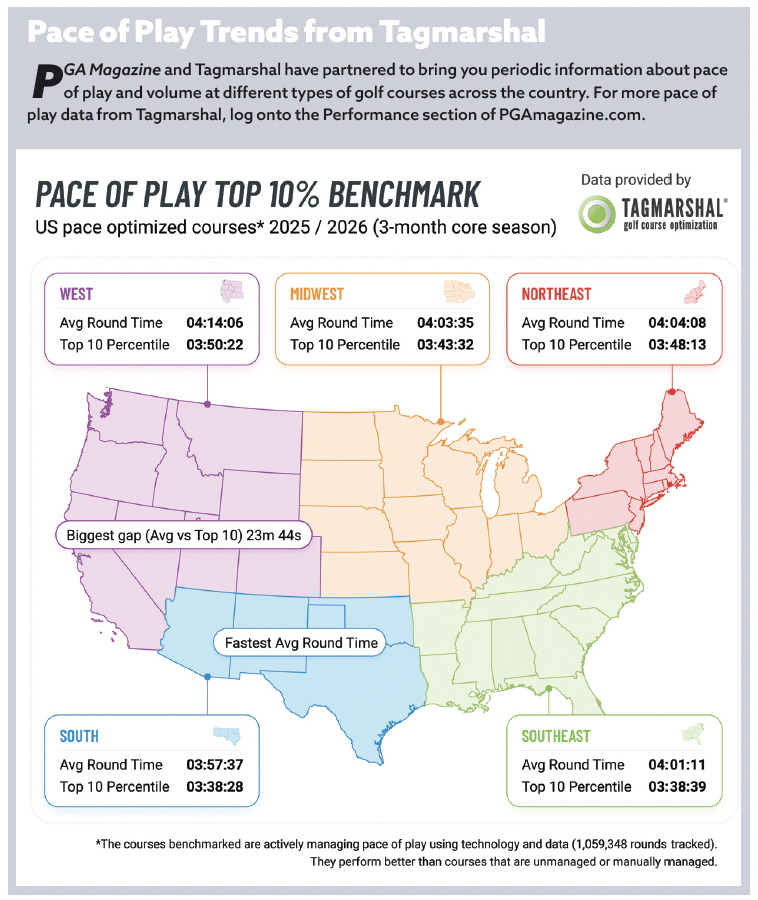
These top performers are benefiting from technology and data that drive proactive pace management.
How leading facilities manage pace and flow effectively
At Wisconsin’s Erin Hills, PGA of America Head Golf Professional Jim Lombardo places a premium on early interventions. By analyzing years’ worth of Tagmarshal data, his staff can identify which groups are potential delayers even before they tee off. Attention is focused on monitoring groups over the first five holes to get ahead of pace before it can mushroom into challenges.
“We communicate our pace of play guidelines to all groups before they tee off,” Lombardo says, “so nobody is surprised when interactions take place.” If necessary, rangers also communicate with caddies about a group’s pace of play using hand signals, so caddies can attempt to get the group back into position quickly without a ranger’s intervention.

Not all interactions are pace warnings and ‘thumbs up’ interactions to groups on pace or ahead are just as important as those where pace of play corrections are needed, as well as dropping back to speak to the groups behind, so they know we are actively working to improve pace.



Baltusrol Golf Club in Springfield, New Jersey, also relies on clear communication and an early intervention system to keep the field moving. The real-time pace of play is visible in the clubhouse at all times via the Tagmarshal Live Map displayed on TV screens. To ensure problem groups are promptly addressed, alerts are sent to staff as soon as a group falls 7 minutes out of position.
Integrations across ForeTees, Tagmarshal, and Golf Genius help to collect data on average round times and identify pockets where they can be more aggressive with tee time intervals, and member profiles highlight which groups should be more closely monitored.
Member enjoyment on the golf course has drastically improved due to pace of play, we have also saved a lot of staff hours by eliminating ranger loops, making us more effective with our time.


Franklin Bridge Golf Club, located just south of Nashville, Tennessee, has managed to hit the sweet spot between providing an enjoyable on-course experience and maximizing tee sheet capacity.
Owner Brooks West, PGA, credits the addition of cart screens that allow players to self-monitor their pace against his course’s goal time of 4h18m for fundamentally shifting the ranger-golfer dynamic, reducing defensiveness and lowering potential tensions. He relies on data to outline two key pace management principles – overall pace and time spent waiting. It is the latter that has the bigger negative effect on how players perceive pace, so attention is focused on monitoring backup holes.”
Dialing in your hole-by-hole pace splits is critical, along with tweaking where your geofences are placed for the ‘start’ of each hole to find the optimal balance. Be sure to consider different tee markers, where golfers naturally park their carts, and how long the turn flow takes and you’ll soon notice improvements.


Advance Golf Partners has built a reputation for highly effective, data-backed pace management strategies across courses in Texas, Missouri, Indiana and Georgia, resulting in highly profitable operations.
General Manager Dan McIntire, PGA, leads the charge at Frisco Lakes GC in Texas, where the focus is on strategic spacing of tee times, active monitoring of on-course positioning via GPS-based monitoring, and consistent player communication.
“We rely heavily on operational data and review round times, gap reports, hole-by-hole performance, peak congestion periods, and historical tee sheet utilization,” says McIntire. “Combining operational observations from our staff with real-time course data gives us a complete picture of how the golf course is performing each day.”
By consistently focusing on early, proactive interventions, Frisco Lakes has seen fewer pace-related complaints, improved staff accountability, and a more enjoyable environment for both members and guests.
Great pace of play doesn’t happen by accident. It comes from setting clear expectations, using data to guide decisions, and addressing small issues before they become big problems.


Benchmarking data is also a powerful tool when reporting to boards and committees. Illustrating that your facility compares favorably against nearby courses, in a key player experience factor like pace and flow of play, indicates that successful on-course strategies are in place. Where the data shows that improvements are needed, a case can be made that additional resources are needed; whether that’s utilizing technology or increasing the number of on-course staff during busier periods of the day or days of the week.
To see how your course’s pace measures against similar facilities in your state or region, use Tagmarshal’s Benchmarking tool below.
You can filter by:
- State (or multiple states)
- Date range (up to the end of July 2026)
- Course type(s)
Drawing on peak period data from courses across the US, the tool will show you the following data:
- Average round time
- Median round time
- Most common 15-minute pace range
The data from our Benchmarking tool is representative of courses that are already using Tagmarshal’s system to optimize pace. Facilities typically see an average round time reduction of 15 minutes or more when effectively utilizing this technology.
Article by Don Jozwiak, Senior Editor, PGA Magazine
Read the full article in PGA Magazine.
ABOUT TAGMARSHAL
Tagmarshal, the market leader in on-course optimization technology, provides courses with full, real-time operational oversight and reporting, giving golf operators the tools to manage pace and flow of play effectively, resulting in enhanced player experiences, increased efficiency through automation, and additional revenue generation.
Tagmarshal’s technology has collected over 100 billion data points from more than 95 million tracked and improved rounds of golf and has relationships with in excess of 900 partners, including Hazeltine, Whistling Straits, Baltusrol, Fieldstone, Bandon Dunes, The Old Course at St Andrews Links, Serenoa and Erin Hills.
Tagmarshal partners with several golf management groups, private, daily fee, public and resort courses, including 50 of the Top 100 courses, as well as many $40-$60 green fee courses, which are seeing excellent results using the system.
SOLUTIONS
 WATCH DEMO

