Our ‘Quick Wins’ series focuses on the proactive pace management strategies in place at some of our standout facilities, where forward-thinking operators have fully embraced the use of technology to ensure a memorable on-course experience.
At Erin Hills, the world-famous Wisconsin course that hosted the 2017 Men’s U.S. Open and 2025 Women’s U.S. Open, Head Golf Pro Jim Lombardo, PGA, and his team have spent more than a decade fine-tuning their approach to improving on-course flow.
As a bucket-list course with a testing layout, the aim is not to rush players through the course, reflected in their goal time of 5h05m, but rather to prevent groups from falling out of position and causing bottlenecks.
Erin Hills uses Tagmarshal’s Classic Tags and Classic Install devices across both cart and walking groups. We asked Jim 5 questions about how the resort course successfully balances delivering a memorable on-course experience with optimizing the tee sheet.
1. What processes have you implemented to improve pace and flow?
One of the best things we have done is implement a series of hand signals that a ranger can give to caddies to communicate the current pace of play. This allows the caddies to attempt to get the group back into position quickly without a guest interaction. Key to that is an aggressive approach to all groups over the first 3-5 holes to establish good pace and stop groups from being delayers before they have time to do so.
2. How do you communicate with players around pace?
We communicate our standard pace of play guidelines to all groups before they tee off, as well as what we will do if a group falls out of position. This way, a group is not surprised when interactions take place. Also, if a group does fall out of position and our team is taking steps to fix that issue, we drop back and speak to groups behind them, letting them know we are actively doing something to improve pace.
3. What data do you rely on to inform your strategies?
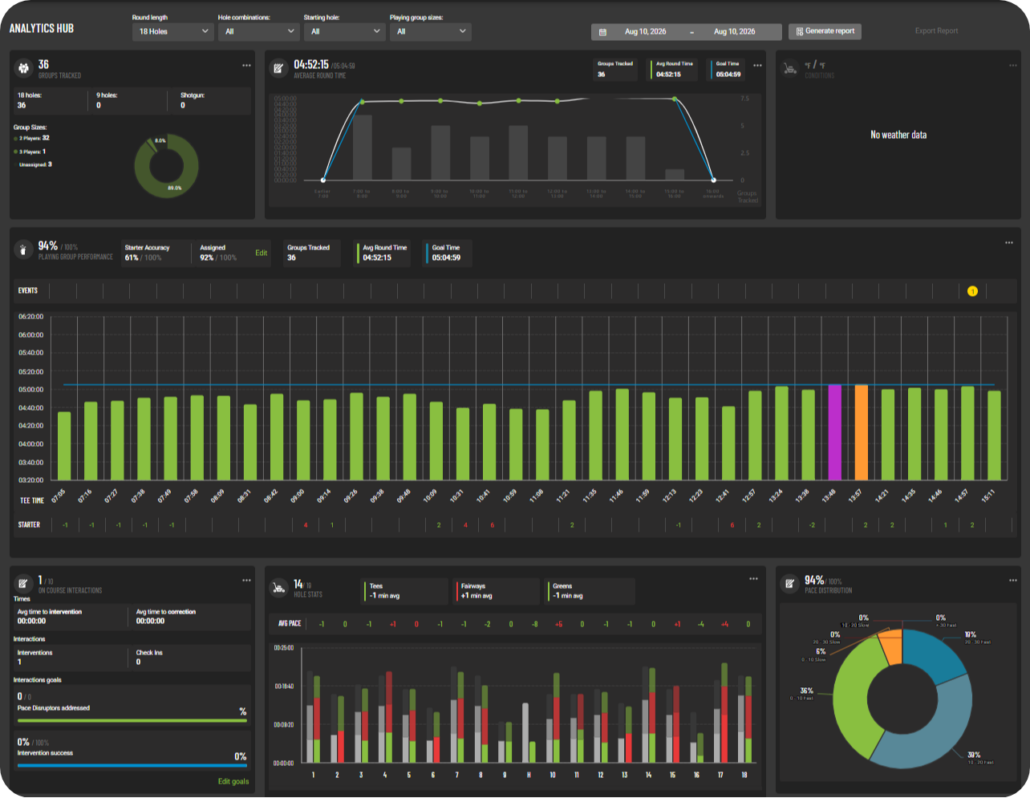
We use Tagmarshal’s data on a daily basis by recording each group type’s or caddie’s tendencies for pace in the Analytics Hub. After gathering data over the years, we have found that there are generally 4 types of groups that have a tendency to be delayers, and we know who they are before they even tee off. Our Starter will announce this information to the team.
We will get ahead of this, and it allows us to be proactive and not reactive. Lastly, each Ranger is required to enter a certain number of interactions with players per day. This can be reviewed to make sure interactions have been taking place with delayer groups. Not all interactions are pace warnings or notifications, and the ‘thumbs up’ interactions to groups on pace or ahead of pace are just as important for our groups as those where pace-of-play corrections are needed.
4. What technology do you lean on to facilitate oversight?
On the course, the Ranger team relies on iPads and tablets to see Tagmarshal in real time. Additionally, every department, including Maintenance, has the Tagmarshal screens up on computers. It is our belief that every department needs to know what is happening on the course at all times. Our caddie department uses our Paylocity system for scheduling to which Starters and Rangers are on the course, to better communicate with caddies and groups.
5. What outcomes have you seen as a result of consistent pace and flow at your operation?
All of our strategies have resulted in controlling pace so much better than pre-Tagmarshal. We see little or almost next to zero pace of play complaints. It is amazing to see the interaction of our staff even when we see a group 5 minutes out of position. We just don’t accept that, and we know to get ahead of pace before it can mushroom into challenges. Ultimately, our goal is to develop repeat customers. If people come, enjoy our course, and feel the round was comfortable, they will come back.

Tagmarshal has enabled us to reduce playtime and add additional tee times. I’d recommend taking a strong look at Tagmarshal. Don’t let yourself fall behind technology.



Tee sheet optimization, made possible by Erin Hills’ proactive approach to managing pace, has resulted in an additional $700k in annual green fees.
To find out more about how Tagmarshal will help your operation more effectively manage pace and flow, watch our short demo video or schedule a live demo.
ABOUT TAGMARSHAL
Tagmarshal, the market leader in on-course optimization technology, provides courses with full, real-time operational oversight and reporting, giving golf operators the tools to manage pace and flow of play effectively, resulting in enhanced player experiences, increased efficiency through automation, and additional revenue generation.
Tagmarshal’s technology has collected over 100 billion data points from more than 95 million tracked and improved rounds of golf and has relationships with in excess of 900 partners, including Hazeltine, Whistling Straits, Baltusrol, Fieldstone, Bandon Dunes, The Old Course at St Andrews Links, Serenoa and Erin Hills.
Tagmarshal partners with several golf management groups, private, daily fee, public and resort courses, including 50 of the Top 100 courses, as well as many $40-$60 green fee courses, which are seeing excellent results using the system.
SOLUTIONS
 WATCH DEMO

