How Golf Cart GPS Systems Solve the Post-Boom Tee Sheet Crisis: Unlocking Hidden Capacity
Golf cart GPS systems are changing how course operators think about tee sheet capacity. In this post-boom golf market, many facilities have to face a difficult reality: demand remains strong, but an 18-hole golf course still has a fixed amount of playable inventory.
If the tee sheet is full, it can feel as if the course has already reached its revenue ceiling. The most obvious response would be to raise green fees, extend operating hours, or squeeze more groups into the same playing window, but these decisions can easily backfire without the right operational insight. A tee sheet that seems more profitable on paper can create congestion, longer rounds, frustrated golfers, and a weaker experience for players.
At Tagmarshal, we look at capacity in a different way. The question shouldn’t simply be how many tee times a course can schedule; it should be how many groups the course can move smoothly through the facility without damaging pace, flow, and the player experience.
It’s here where data-driven interval management becomes so powerful. By using real-time tracking, historical round data, pace analytics, and proactive alerts, courses can safely find hidden capacity to unlock. This way, courses don’t have to guess whether intervals can be tightened; they can see where the field is flowing well, where bottlenecks are forming, and where revenue opportunities exist without compromising the round.
In this article, we’ll cover how golf cart GPS systems are helping courses address the challenge of tee sheet capacity.
Golf Cart GPS Systems: The Full Tee Sheet Fallacy

A full tee sheet doesn’t always mean the most optimized tee sheet. It just means that all of the available playing slots have been booked.
In practice, though, hidden inefficiencies can exist throughout the day. For example, groups may start late, some time blocks may play faster than others, a difficult hole may create a backup, the turn may slow down the transition to the back nine, or a few groups may fall out of position and create gaps that are never recovered.
Without data, these issues can be difficult to see. From the golf shop, the schedule may seem perfect. On the course, however, the field may be bunching in one place and opening up in another. That’s the gap between theoretical capacity and real capacity. Theoretical capacity is what the tee sheet says should happen, while real capacity is what the course can actually handle while preserving the experience.
When operators try to create extra revenue without fully understanding this difference, they often narrow intervals across the board. This creates more starting times, but it can easily push too many players onto the course at once, leading to a less-than-ideal experience for everyone.
The Science of Tee Intervals
At a glance, tee interval math looks simple. Across an eight-hour morning block, 10-minute intervals create 48 starting slots. Nine-minute intervals create roughly 53, eight-minute intervals create 60, and seven-minute intervals create around 68.
On paper, the shorter interval looks like the most appealing option. The course appears to create more inventory without changing the property. But golf does not work like that; groups do not all move at the same speed, holes do not take the same time to play, and small delays can compound quickly.
A slow first group, an early par 3, a difficult drivable hole, a ball search, or a late start can compress the field. When the interval is too tight, following groups have nowhere to go. They just have to wait. The extra capacity that at first seemed valuable on the tee sheet becomes visible frustration on the course. As a course operator, the last thing you want is groups of frustrated players.
The ideal interval time, therefore, can’t be decided purely based on math. It must be measured against the actual behavior of the course. A 9-minute interval may work well during one period of the day and create problems during another. A single two-minute delay can easily become a 25-minute slowdown by hole 6. The key is to understand the course’s actual operating rhythm.
Understanding Hidden Capacity
To unlock a course’s hidden capacity, operators generally need to make several small improvements instead of one major, aggressive change.
The first important consideration is starter accuracy. If groups are not starting on time, the tee sheet begins losing integrity from the first tee. A group that leaves late can affect the groups behind it, especially when the first few holes are already pace-sensitive.
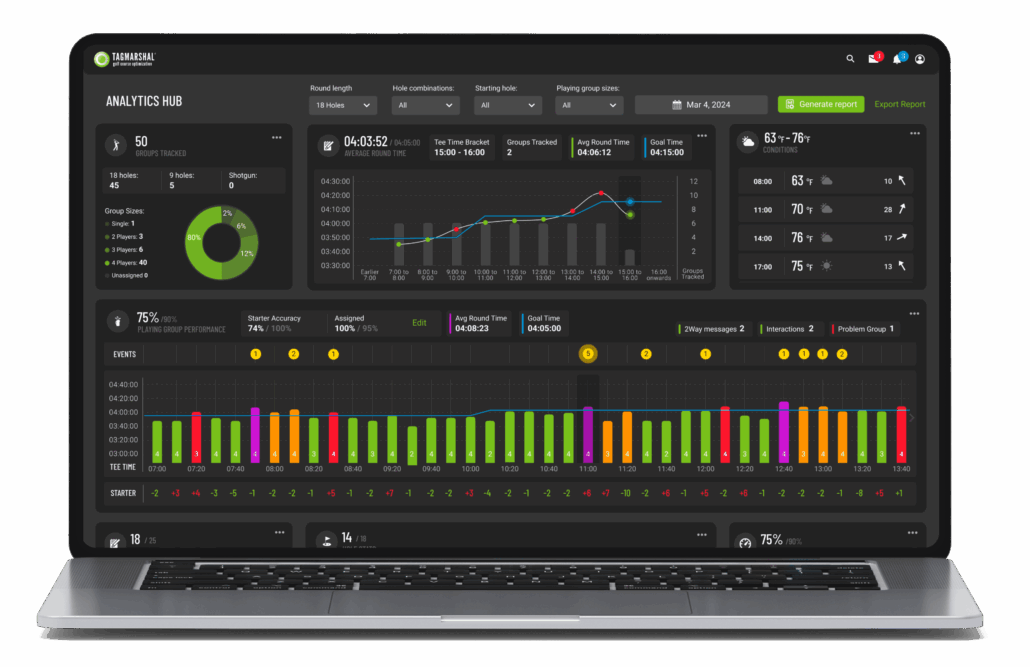
Another issue is micro-gaps. These are small pockets of unused space that appear between groups when the field is not being managed consistently. A course may be fully booked but still have moments where groups are spaced inefficiently.
Hole-specific bottlenecks also matter. A course may not have a whole-course capacity problem; it may have a Hole 3 problem, a Hole 6 problem, or a par-3 bottleneck that limits flow for the rest of the front nine. Without hole-by-hole data, those pressure points get blamed on “slow golfers” rather than properly identified as structural issues.
Turn times can also hide lost capacity. If groups lose position at the halfway point, the back nine begins under pressure. Even when the front nine starts well, inefficient transitions can reduce the course’s effective capacity.
Tagmarshal’s Analytics Hub helps operators understand these issues by bringing pace and flow data into one central platform. Starter Accuracy data shows the impact of late tee-offs, Hole Stats data shows where players wait on tee boxes and where bottlenecks are likely to occur, and Pace Distribution highlights how completed rounds compare with goal time, giving a more complete picture than round time alone.

How Narrowing Intervals Can Backfire
We can see why it’s easy to make the mistake of thinking that extra tee times automatically mean extra revenue. It’s possible, but only if the course can handle it.
If the field becomes congested, the player experience gets worse. Golfers wait longer, staff receive more complaints, and the course can soon develop a reputation for slow rounds – the last thing that golfers want. In the short term, the tee sheet may look more valuable, but over time, poor pace will hurt retention, reviews, and repeat play.
In a market where golfers have high expectations regarding time, convenience, and value, this is incredibly important. A player who pays a premium green fee expects the round to run smoothly and feel organized. An overloaded course will naturally put players off from wanting to return in the future.
Pace is both an operational issue as well as a revenue issue. The goal should not be maximum compression; it should be maximum sustainable flow. A course needs to understand where intervals can be tightened safely and where more space is needed to protect the round from descending into an unpleasant experience.
Golf Cart GPS Systems: Moving To Proactive Field Flow

The old way of marshaling was reactive in nature, and as such, traditional pace management would often start too late. A player assistant may only respond after a delay becomes obvious, a complaint comes in, or a group has already lost position. At this point, the course may already be bunched up, and players may end up having a frustrating experience.
Reactive marshaling can be inefficient. Staff have to search for problems, drive the course, speak to groups, and try to restore pace after the field has already been disrupted. By the time any changes are made, the issues may have already escalated.
Tagmarshal helps courses move from reactive player assistance to proactive field flow. With real-time tracking and Live Map visibility, staff can see where every group is, whether they are on pace, whether they are being delayed, and whether they are causing delays. Not every out-of-position group is at fault, so it’s important to understand this distinction.
Our Pace Disruptors feature adds another layer of intelligence. Using AI and machine learning, the system identifies problem groups before they negatively affect the rest of the field. Tagmarshal gives operators the power to set their own limits for what counts as out of position, and alerts can be activated whenever intervention is needed.
How Tagmarshal’s Golf Cart GPS Systems Help Operators Unlock Capacity Safely
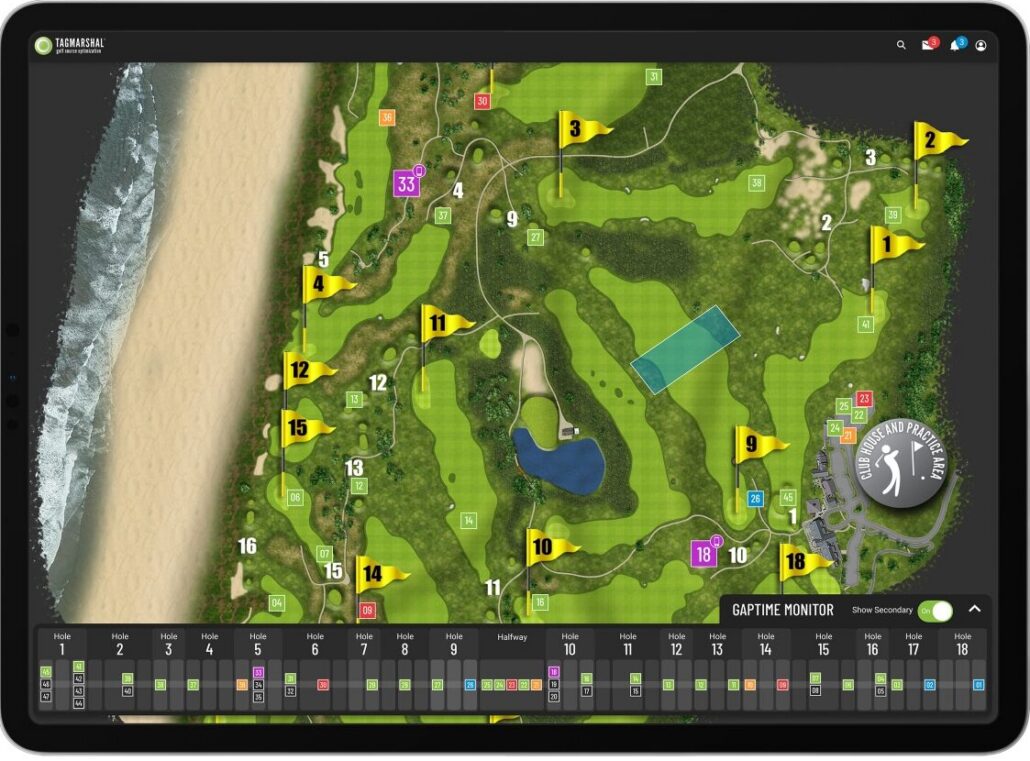
Tagmarshal allows operators and staff members to see a live visual view of interval spacing across the entire course. Via the Live Map and the Gap Time Monitor, teams can see where every playing group is, how much space exists between groups, and whether that spacing is beginning to compress or stretch. This turns field flow into something that staff can actively manage in real time.
This is especially important when course operators are trying to optimize tee sheet capacity. Tagmarshal’s Gap Time Monitor visually displays the distance and time between playing groups, helping staff identify groups that are falling out of position or creating early bottlenecks. As such, staff don’t have to wait for a delay to get involved; they can spot expanding gaps, get involved earlier, and keep groups moving at more consistent intervals.
With this level of proactive visibility, courses can test capacity changes more safely. Tagmarshal helps operators understand when play is naturally faster, where interval gaps can be tightened, and whether changes are affecting the player experience.
The real-world results speak for themselves. Morgan Creek Golf Course increased prime-time availability by two morning tee times at rack-rate prices while reducing average round time by four minutes. Fieldstone Golf Course also recorded an 85% rise in revenue across its first 3 seasons using Tagmarshal.
Golf Cart GPS Systems: Balancing Throughput With Enjoyment
Unlocking hidden capacity only works if golfers still want to return. That’s why interval management must always be connected to the playing experience. A course may be able to add additional groups, but if rounds become slower and frustrating, the extra revenue may be offset by reduced repeat play because of a bad playing experience.
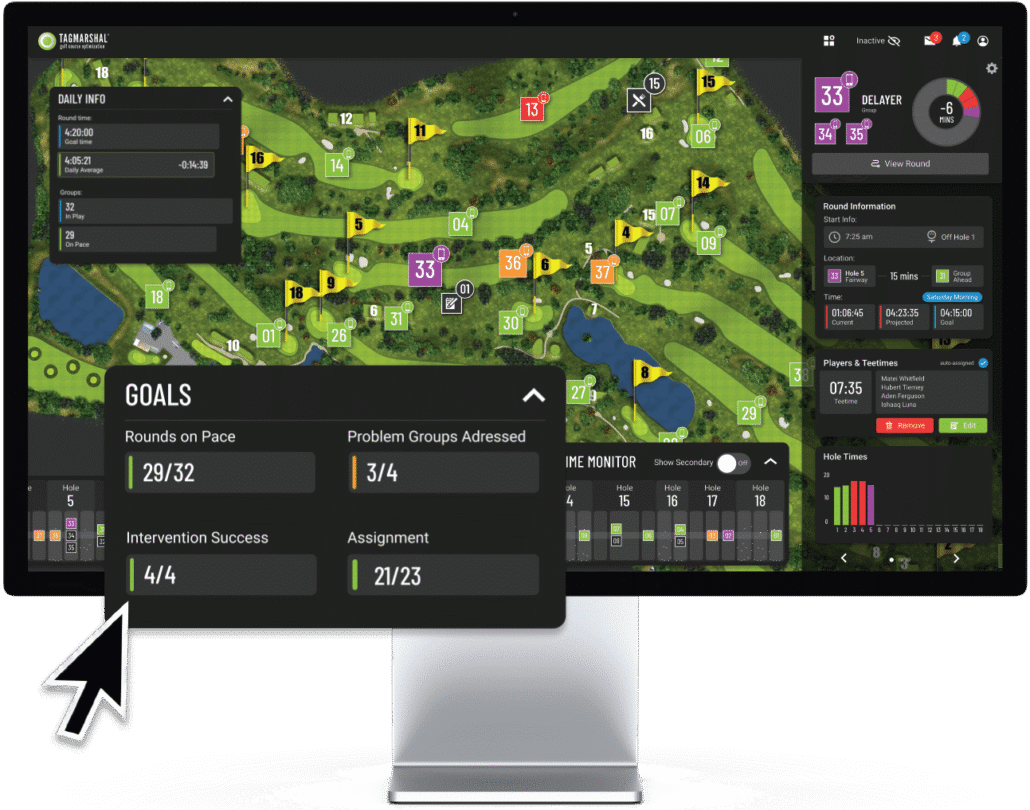
Tagmarshal’s data helps operators properly monitor that balance. Customizable Widgets can show the information that team members need most, including course goal time, the running daily average round time, number of groups in play, number of groups on pace, problem groups addressed, and intervention success.
Pace management is then easier to communicate across the team. All staff members can work from the same operational view.
For courses using 2Way devices, communication can also reach the players directly. Groups can get alerts with pace information and reminders without every intervention needing an in-person conversation.
Golf Cart GPS Systems and Hidden Tee Sheet Capacity
To solve the post-boom tee sheet crisis, operators need the full course picture. On paper, shorter intervals may create more inventory, but they can easily create congestion, frustration, and retention problems. The real opportunity lies in flow.
Courses that understand their pace patterns, bottleneck holes, starter accuracy, and time-block performance can identify where capacity exists and where the field needs more space.
At Tagmarshal, we help courses make these decisions with confidence. Our golf cart GPS systems provide real-time tracking, Analytics Hub insights, Pace Disruptors, Customizable Widgets, and 2Way communication tools.
Discover how our golf cart GPS systems help operators get the most out of their courses through smarter, data-driven interval management.
UNLOCK YOUR FACILITY’S HIDDEN CAPACITY WITH TAGMARSHAL
Watch Demo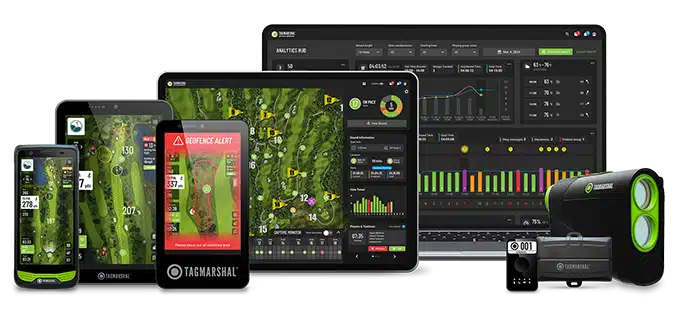
ABOUT TAGMARSHAL
Tagmarshal, the market leader in on-course optimization technology, provides courses with full, real-time operational oversight and reporting, giving golf operators the tools to manage pace and flow of play effectively, resulting in enhanced player experiences, increased efficiency through automation, and additional revenue generation.
Tagmarshal’s technology has collected over 100 billion data points from more than 95 million tracked and improved rounds of golf and has relationships with in excess of 900 partners, including Hazeltine, Whistling Straits, Baltusrol, Fieldstone, Bandon Dunes, The Old Course at St Andrews Links, Serenoa and Erin Hills.
Tagmarshal partners with several golf management groups, private, daily fee, public and resort courses, including 50 of the Top 100 courses, as well as many $40-$60 green fee courses, which are seeing excellent results using the system.
SOLUTIONS
 WATCH DEMO

