5 critical 2025 industry data learnings to implement this season
Tagmarshal has partnered with Players 1st, the golf industry’s leading customer experience management tool, to combine our wealth of on-course data with their unrivalled player feedback data.
By correlating the data our system gathers alongside extensive feedback from players, we can pinpoint some 2025 learnings and better understand which changes will have a positive impact on player sentiment in 2026.
2025 NPS Trends
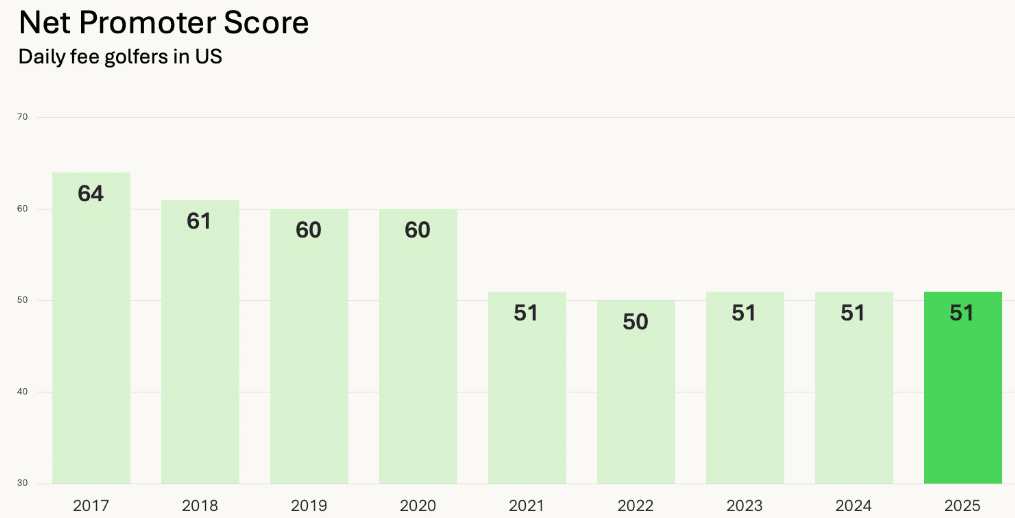
Players 1st’s data, gathered from more than 3,000 facilities and covering millions of player responses, shows that the Net Promoter Score (NPS) of daily fee golfers in the US remains low.
This is gauged by asking one simple question – “How likely is it that you would recommend this golf course to friends, family or colleagues?” – with a ranking from 0 to 10 and a score given out of 100.
While the daily fee NPS score actually improved slightly across 2025 (from 47 to 49), there was a noticeable decline in municipal courses’ NPS (down 9 points to 48), while resort and semi-private courses remained steady at 58 and 59, respectively.
1. Tailor your player experience to golfer segment needs
Understand who is playing your course
Not every golfer who steps up to the first tee wants the same on-course experience. Expectations vary greatly across segmentations like age, gender, handicap index, and membership types.
Players 1st’s data shows that younger golfers have a significantly lower NPS score than golfers aged 65 and above (38 versus 59), as they are often more pressed for time and place a higher premium on pace of play as a result.
Your facility needs to understand who is playing the course and tailor the experience you provide accordingly. For example, when asking players to move back into position, use Tagmarshal’s 2Way messaging capabilities to customize communication for first-time golfers versus experienced golfers.
Reduce the required effort to recognize golfers and trends
Even at daily fee courses, there is a high volume of repeat play from the same golfers. If you can consistently track who is playing and when, you’ll be able to identify trends more easily and recognize who is visiting your facility for the first time, so you can tailor the experience.
Tagmarshal has automated the entire process by integrating with more than 25 leading tee sheet providers to automatically pull player names through from the tee sheet.
This allows you to build out extensive player profiles, with full pace histories and other key data points tied to player names in the system.
Enhance your level of on-course service
The more data you gather, the more opportunities you open up for personalized service.
That could be keeping notes on when members like to have a certain drink or food delivered, and using Tagmarshal’s Live Map to see precisely where they are, or ensuring that a certain player is given extra attention during their first round.
2. Be proactive and data-driven with pace management
Be proactive, not reactive
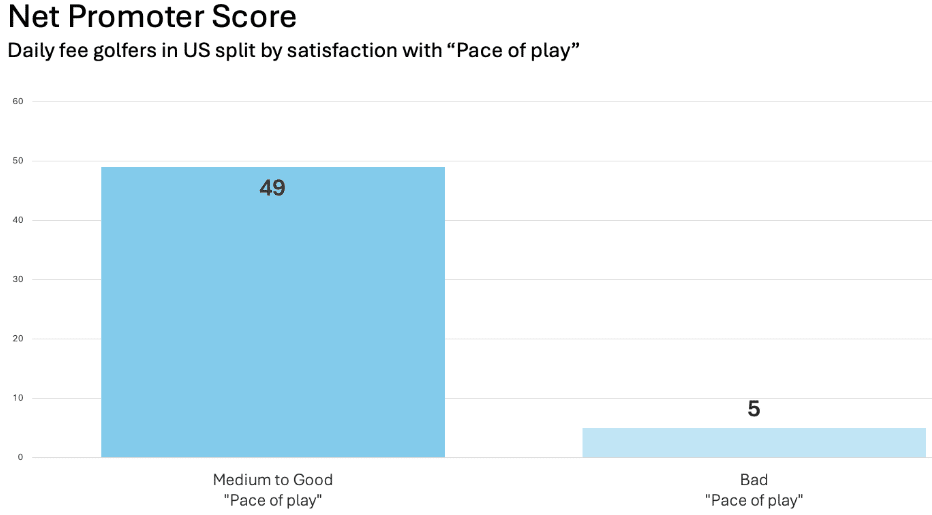
At daily fee courses where players rated pace of play medium to good, the average NPS was 49. However, where pace was rated bad, NPS dropped to 5.
Using real-time data to inform where interventions will have the most impact, and ensuring your on-course staff intervene before the entire field is affected, will not only transform how you manage pace, but also how players perceive your facility’s approach to doing so.
Know your ‘crunch’ times
Understanding how your average round times differ across times of the day, and days of the week, is critical.
When you know when and where bottlenecks are most likely to occur, you can move staffing resources from periods where they might not be as necessary (early morning rounds, for example) to periods where interventions and monitoring will be more impactful.
Communicate clearly with players around pace
Managing pace effectively starts with communicating your expectations to your golfers.
At daily fee and resort courses, setting these expectations starts with having your pace policy clearly outlined on your website, which can be reinforced during the booking confirmation process, at check-in on the day, and by your starter and on-course staff.

If your pace is bad, it has a direct, huge impact on your NPS score and it’s also going to cost you in food and beverage spend and other revenue-generating areas.



3. Encourage positive on-course interactions
Reframe marshals as player assistants
Data from Players 1st shows that when players on daily fee courses met on-course staff during the round, the average NPS was 57. When they didn’t meet on-course staff at all, NPS dropped to 40.
Reframing the marshal role as a player assistant, and shifting the focus from policing the field to facilitating a more enjoyable experience, will have a measurable impact on your operation.
When players meet on-course staff and have a positive interaction, we see a huge increase in their NPS. Every engagement is a chance to leave a positive mark – they are very important touchpoints.
Use data to change perceptions around pace

Most on-course discussions with groups that have fallen behind pace are likely to feature pushback from golfers with the standard ‘it’s not us, it’s the group in front’ excuse.
Give your staff data to rely on and share with players, and these conversations can be entirely reframed as fact-based and neutral.
Players are more likely to take heed, and they can also see firsthand that your facility is taking steps to effectively manage pace and provide an enhanced experience for all golfers.
Track and measure intervention success
An on-course intervention is only successful if the group in question actually gets back into position, and there is a tangible improvement in pace and flow of play.
Tagmarshal measures this success rate and makes it easy to report on so that it can be monitored. If your success rate is low, additional training may be required to ensure interventions are more effective.
4. Understand your market position and golfer expectations
Understand your local golf ‘ecosystem’
Your facility doesn’t exist in isolation, because players will measure it against other courses in your area across criteria like pace and flow, course conditioning and design, and cost / value, among others.
What do players expect when they come to play your facility, and do you deliver on those expectations? It’s not always about providing the most premium experience, but you need to make sure that what you promise and what you deliver are aligned.
Use data to recognize opportunities
How does your facility stack up against other local courses when it comes to key criteria, and what improvements will have the biggest impact on driving repeat play and increasing retention?
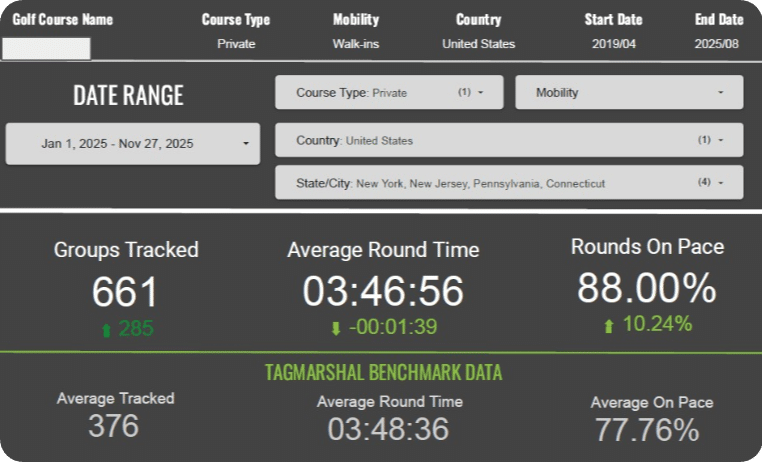
Players 1st’s Benchmarking tool exposes patterns and opportunity gaps that are invisible in your own data alone, allowing you to dig deeper and compare the feedback you receive.
Tagmarshal’s Benchmarking feature operates similarly, comparing data like average round time, percentage of rounds on pace, and volume of play by facility type and state so you can identify where you are outperforming facilities and where you may need to improve.
Market your facility smartly
Once you understand how you measure up against other courses, you can pinpoint exactly what sets you apart and use this as a powerful marketing tool.
For example, stating that you are in the top 20% for rounds on pace in your state, or the top 10% nationally for average round time, will resonate with golfers who value pace and flow highly and are looking for a new course to play.
5. Listen to your golfers and impact the most crucial touchpoints
Listen
Golf has an exceptionally high survey response rate.
Finding a way to get feedback directly from your players, in an easy way, makes them feel heard and shows that you value their input.
Interpret
Once you have gathered sufficient feedback data, you need to identify the key drivers behind golfer satisfaction at your facility, as well as the shared concerns and gripes that are detracting from the experience.
Look for patterns in your responses, or rely on Players 1st’s sentiment tracking, with a dashboard that tells you what matters most to respondents and AI tools that summarise the comments and make recommendations.
React
Closing the loop by making informed decisions based on feedback and reviewing your actions to see the results is incredibly important.
When your players see their concerns and gripes being acted on, it builds trust and increases the likelihood that what they previously saw as detractors (things that adversely affected their on-course experience) will convert to promoters (aspects that enhance the experience and increase NPS).
You have to close the loop. You ask for feedback, you get the feedback, and then you must take action, or else you are actually in a worse place than before.
Conclusion
As the golf industry at large continues to move towards a more tech-enabled experience, opportunities arise for facilities to gather and utilize data to enhance the experience they offer in a way that resonates with today’s players.
Powered by industry leaders like Tagmarshal’s optimization system and Players 1st’s customer experience management tool, your operation can make informed decisions that will ensure success through the 2026 season and beyond.
ABOUT TAGMARSHAL
Tagmarshal, the market leader in on-course optimization technology, provides courses with full, real-time operational oversight and reporting, giving golf operators the tools to manage pace and flow of play effectively, resulting in enhanced player experiences, increased efficiency through automation, and additional revenue generation.
Tagmarshal’s technology has collected over 100 billion data points from more than 95 million tracked and improved rounds of golf and has relationships with in excess of 900 partners, including Hazeltine, Whistling Straits, Baltusrol, Fieldstone, Bandon Dunes, The Old Course at St Andrews Links, Serenoa and Erin Hills.
Tagmarshal partners with several golf management groups, private, daily fee, public and resort courses, including 50 of the Top 100 courses, as well as many $40-$60 green fee courses, which are seeing excellent results using the system.
SOLUTIONS
 WATCH DEMO

